Where to stay in Rome if you’ve already done the tourist trail
This page contains affiliate links. If you make a purchase through one of these links we make a small commission to help run this site, at no cost to you. Making a commission never affects the advice we give - see our content policy.
Most guides on where to stay in Rome are written for first-time visitors. They’ll point you toward the centro storico near Piazza Navona, recommend a hotel near the Colosseum, and encourage you to go to Trastevere. Fair enough if you haven’t been before – the best area to stay in Rome for first-time visitors is still the historic centre because everything is walkable and the major sights are on your doorstep.
But if you’ve already ticked off the Colosseum, the Vatican, and the Trevi Fountain, staying in the same tourist-heavy streets doesn’t make a lot of sense. You’ll pay more for accommodation, eat worse food, and see a version of Rome that’s mostly designed for people who are there for the first time.
Rome is more walkable than most people expect. Staying 20 minutes on foot from the Colosseum is a nice walk. For anything further, the metro and buses work fine. We’ve included the nearest metro stop and walking times for each neighbourhood so you can judge for yourself.
This guide covers five neighbourhoods that most where-to-stay guides leave out – the places we’d book on a return visit (or recommend to anyone who’d rather skip the crowds on their first trip). We’ve included honest pros and cons for each, transport connections, and hotel picks at different budgets with real prices.
Our top picks if you’re in a hurry
🏨 Best for food: Seven Suites in Testaccio is next to Rome’s best food market, from £150 / €170 per night.
🏨 Best for peace and quiet: The Corner Rome on the Aventine – leafy residential area, from £180 / €206 a night.
🏨 Best mid-range all-rounder: Trastevere Colours is a comfortable guesthouse with large, clean rooms and great facilities. Rooms are from £150 / €170 a night.
🏨 Best Splurge option: The Sanctuary is one of Rome’s most unique hotels, with calm space and facilities, from £210 / €206 a night.
Map of our top picks
We’ve plotted our top areas on the map below.
Testaccio
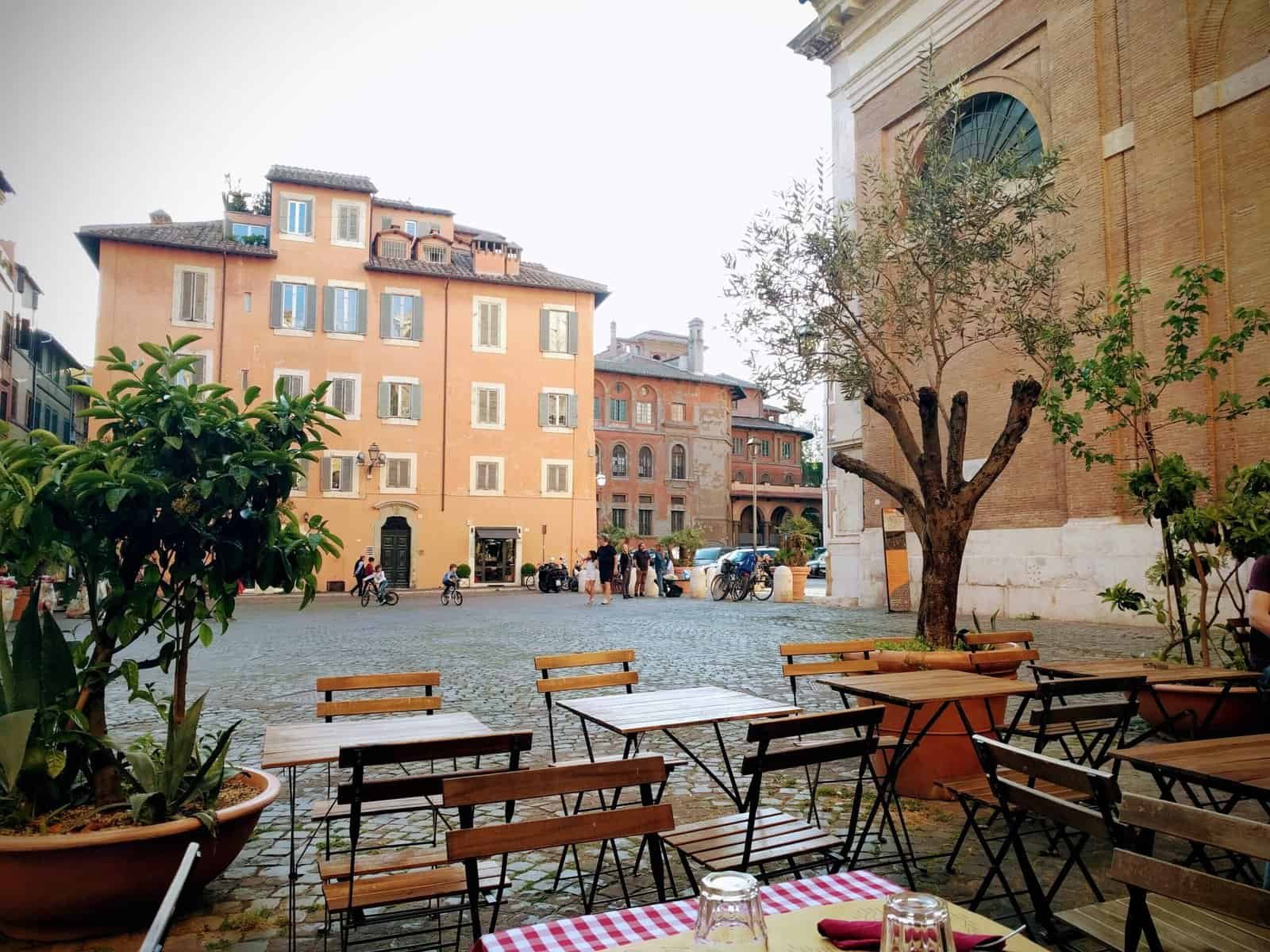
Testaccio doesn’t look like much when you first arrive – we were a bit underwhelmed. It’s a grid of residential blocks from the late 1800s, a covered market, some bars, and a lot of Romans doing their shopping. There are no ancient columns or big piazzas, and it’s just a normal neighbourhood where people live.
But, is a great neighbourhood to explore and filled with excellent food options.
The neighbourhood grew up around Rome’s old slaughterhouse (which is now an art gallery), and the workers used to take home the cheap cuts that couldn’t be sold. So the local cooking tradition is built on offal, slow-cooked meats, and heavy pasta dishes. Cacio e pepe, carbonara, coda alla vaccinara were all pretty much developed here, and they’re still served in local restaurants in the area.
If it’s your first time and you want to be near the tourist attractions, have a look at our 4-day Rome itinerary which covers where we stayed on that trip.
What’s in Testaccio
The main draw is Testaccio Market (Mercato di Testaccio), which is a modern covered market where locals buy fruit and veg, and a handful of street food stalls do supplì, trapizzino, and porchetta sandwiches. It’s busy in the mornings, quieter by early afternoon, and a good place to grab a quick lunch. It’s not a tourist market but a place where Romans go to eat.
The old slaughterhouse complex (the Mattatoio) has been converted into a contemporary art space with rotating exhibitions. It’s free for general access with paid exhibitions (the price varies depending on the exhibition but are normally around €10). The building itself is worth a look even if the art doesn’t interest you (it still has the old meat hooks on the ceiling, and big industrial spaces). Next door is the MACRO Testaccio gallery.
The Non-Catholic Cemetery (Cimitero Acattolico) is in the eastern edge of the neighbourhood. Keats and Shelley are buried here under cypress trees. Entry is free (donation suggested), and you’ll likely have it mostly to yourself. Right next to it is the Pyramid of Cestius, an ancient Roman pyramid sitting in the middle of a road junction, which doesn’t make it into most guidebooks.
At the base of Monte Testaccio (the hill the neighbourhood is named after, which is made entirely of broken ancient Roman clay pots), there’s a strip of bars and clubs built into caves. They’re pretty fun on the weekend.
Who Testaccio works for
Try Testaccio if you’ve already done the big Rome sights and want to settle into a neighbourhood for a few days. It’s great if you prefer to see some of ‘real’ Rome with normal people going about their day, rather than picture perfect streets.
It works well for couples, and especially people who want to enjoy real Roman food and places to eat – you’ll find authentic restaurants filled with Italians, rather than laminated menus in English and other tourists.
If it’s your first time in Rome and you’ve only got 3 days, we’d say consider centro storico or Monti instead. But if you’ve already done those, there’s not much reason to pay extra to stay there again.
Getting around
Piramide metro station (Line B) is right on the edge of the neighbourhood. Two stops to the Colosseum, four to Termini, and you can switch to Line A there for the Vatican area.
From the middle of Testaccio it’s about 20 minutes walk to the Colosseum, 15 minutes across the river to Trastevere, and 30-35 minutes to the centro storico. It’s an easy walk, and all flat. The walk to the Colosseum along Via Marmorata passes the Pyramid of Cestius, which is worth checking out.
For airport transfers: the FL1 regional train from Fiumicino stops at Roma Ostiense station, which is a 10-minute walk from Testaccio. It costs around €8, which is cheaper and more direct than the Leonardo Express to Termini if you’re staying in this part of the city.
Where to stay in Testaccio
On a budget: Hotel Santa Prisca is a mid-sized hotel set in it’s own gardens in a quiet area of Testaccio. It’s rooms are a bit older but clean and very spacious, with some nice period features. Breakfast is great, and included. It’s around £90/€100 per night. It’s close to the main tourist sites, as well as nearby shops, cafes and restaurants. See pictures and more details.
Mid-range: Seven Suites is the small guesthouse we stayed in. It’s right in the middle of Testaccio on Via Nicola Zabaglia, a few minutes from the market. Rooms are simply decorated, clean, and modern. Most have balconies and terraces looking onto the street below. It’s around £150/€170 per night depending on the season, which is roughly half what you’d pay for something similar near the Pantheon. See pictures and more details.
Splurge: There aren’t many splurge options in Testaccio but instead you can find some excellent apartments which give you a bit more space. Casa de Testaccio is one of them – it’s a beautiful apartment in an old building, but with lovely modern touches. It has a great view of the river Tiber, and rooms are clean, spacious and well-decorated. See pictures and more details.
The downsides
The architecture is mostly 19th and 20th century residential blocks. It’s fine, but it’s not what you see on postcards.
The nightclub strip at the base of Monte Testaccio gets loud on weekend nights. Avoid booking on Via di Monte Testaccio if you’re a light sleeper. A few streets back and it’s quiet.
The market is closed on Sundays, and the rest of the neighbourhood can be quiet too.
On the positive side: you can still eat a three-course meal with wine here for under €30 a person. In a city where tourist restaurants charge €18 for a mediocre carbonara, that counts for a lot.
Pros: Great food, affordable hotels, good metro access, quiet and residential, close to Trastevere on foot
Cons: Not photogenic, limited sights, quiet on Sundays, clubs can be loud on weekends
Aventine Hill (Aventino)
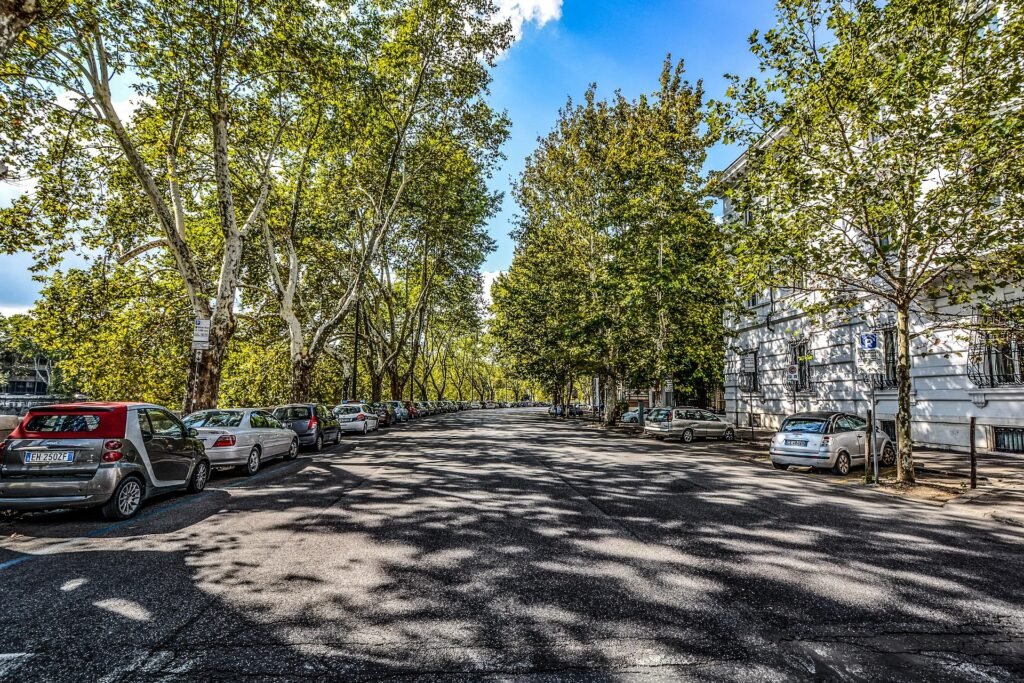
The Aventine sits above Testaccio and it’s about as different from the centro storico as you can get while still being in central Rome. It’s the southern-most hill of Rome’s seven hills.
It’s a quiet, leafy, residential hill with wide streets, convents, embassies, and very few tourists. If you’ve spent previous trips fighting through crowds at the Colosseum and trying to eat near Piazza Navona without getting ripped off, staying here feels like a holiday from your holiday.
We walked up here from Testaccio one afternoon and the change was immediate with big trees, almost no traffic and nuns walking past.
What’s in Aventine Hill
The main draw for visitors is the Giardino degli Aranci (Orange Garden), which has an amazing view over the city toward St Peter’s that’s better than most of the paid viewpoints.
A couple of minutes away is the Knights of Malta priory, where you can look through a keyhole in the gate and see St Peter’s dome perfectly framed by a hedge-lined path. It’s one of those Rome things that sounds gimmicky but is worth seeing (go early to beat the queues).
The Basilica of Santa Sabina is also up here and it’s one of the oldest and most peaceful churches in Rome. Not many tourists visit it, but it’s worth seeing if you’re in the area.
Who Aventine Hill works for
The Aventine is best for people who want somewhere calm to sleep and don’t mind walking or taking the metro to get to things during the day.
It’s well suited to couples and families with young kids.
It’s not great if you want nightlife, a wide choice of restaurants on your doorstep, or the buzz of being in the thick of things. There are a few restaurants nearby, but you’ll probably end up eating in Testaccio (15 minutes downhill) or Trastevere most evenings.
Getting around Aventine Hill
Circo Massimo metro (Line B) is at the bottom of the hill. It’s one stop to Colosseum and three to Termini.
It’s a 20 minutes downhill walk to Testaccio, 20 minutes to the Colosseum, and 25-30 to the centro storico. The walk back up after dinner is a workout, but that’s the trade-off for staying somewhere quiet.
Where to stay in Aventine Hill
On a budget: B&B Circus Maximus is a small, local hotel on the edge of Aventino. It has a lovely roof terrace looking onto the leafy classical housing of Aventino, and comfortable, clean rooms. It’s run by the excellent Claudia, and it’s close to the Colosseum and metro station. It’s from £110/€125. See pictures and more details.
Mid-range: The Corner Rome is a beautiful hotel just down the road from B&B Circus Maximus. We loved it’s clean, classical rooms with excellent design features, and a bar and Michelin starred restaurant onsite (with fantastic al fresco dining). This one’s tipping into Splurge territory, but if you book ahead and outside peak season then you get get rooms from £180/€206 per night. See pictures and more details.
Splurge: The Sanctuary Urban Retreat is one of the most unique places we found in Rome. Rooms are modern and styled with understated, earthy tones using natural materials. It’s a bit closer in to the historic centre, and it’s set in it’s own gardens. Breakfast is very highly rated, as is the service, and there’s a spa and bar on site. Prices are generally from £210/€240 per night, but they drop to £165/€190 in August. See pictures and more details.
The downsides
There’s not much to do on the Aventine in the evening. It’s residential in the way that means shut-by-9pm residential. If your hotel doesn’t have a bar, you’re walking downhill to find a drink.
The hill is a hill. If you have mobility issues or just don’t fancy walking up a steep slope after a long day, factor that in.
Pros: Peaceful, beautiful views, some of Rome’s best-value boutique hotels, close to metro
Cons: Very quiet at night, limited restaurants, uphill walk home, not much to do in the immediate area
Southern Trastevere (the quieter side)
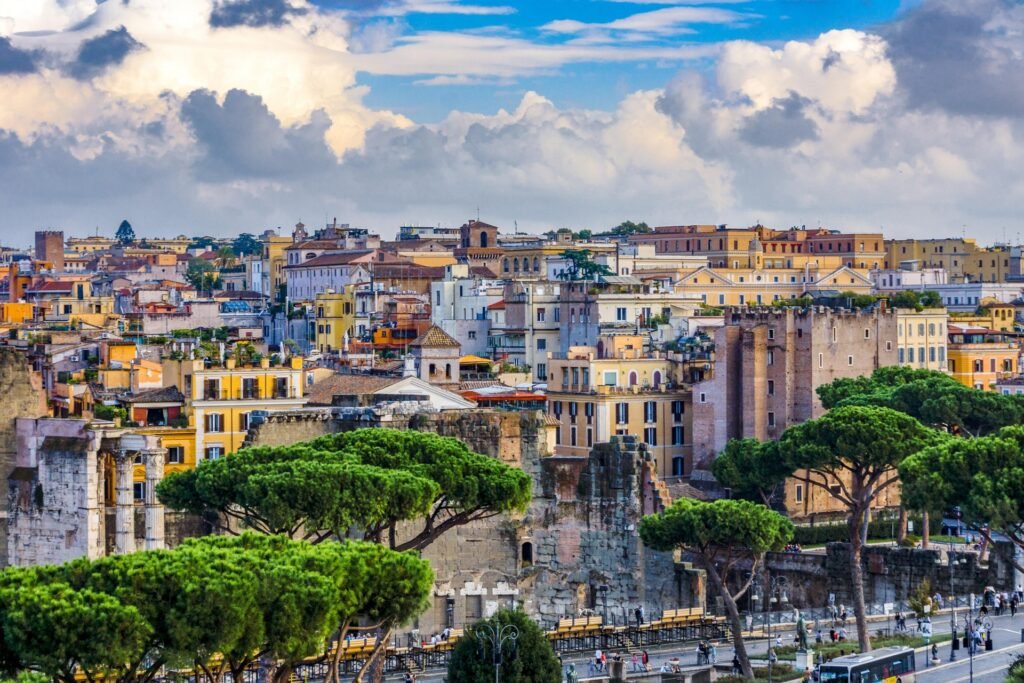
Trastevere appears in every where-to-stay-in-Rome guide – it’s one of the most pleasant neighbourhoods to walk around in the city, with cobbled streets, ivy-covered buildings, and good restaurants. The problem is that the part most guides recommend (north of Viale di Trastevere, near the basilica and Ponte Sisto) are very touristy, loud at night, and expensive.
We’ve found that Trastevere (south of Viale di Trastevere) is a different experience. It’s quieter, cheaper, and more residential. This is where the people who live in Trastevere tend to live as opposed to the northern strip, which is geared toward visitors.
We spent most of our evenings in the northern part of Trastevere and enjoyed it, but we were glad to walk back across Viale di Trastevere to somewhere quieter at the end of the night. If we were booking Trastevere accommodation again, we’d look south of that main road.
What’s in Southern Trastevere
The Botanical Garden (Orto Botanico) is tucked away on the southern side and it’s worth a visit. It’s cheap to enter, almost empty, and a good place to cool down on a hot afternoon.
The church of San Francesco a Ripa is an ornate and peaceful church, and it doesn’t see too many tourists. It has a famous Bernini sculpture (Blessed Ludovica Albertoni) which is worth seeing. The streets around Piazza di San Cosimato have a local market and a handful of restaurants that are more oriented toward residents than tourists.
Who it works for
Southern Trastevere is good for couples and anyone who wants the Trastevere atmosphere without the 1am noise. You’re a 10-minute walk from the busy restaurant strip if you want it, and 20-25 minutes from the centro storico on foot.
If you’re visiting Rome for 3 days on a first trip with a checklist of tourist attractions, the centro storico is probably a better bet for pure convenience. The best area to stay in Rome for sightseeing is still the historic centre if you’re short on time. But if you’ve got a few more days and your priority is eating well and wandering around, southern Trastevere is a great option.
Getting around
Trastevere has no metro station, which is its biggest practical downside. Tram 8 runs along Viale di Trastevere and connects to Largo di Torre Argentina (useful for the centro storico). Bus H is also helpful.
Otherwise, it’s a 20-25 minutes walk to the centro storico, 25-30 to the Vatican, and 15 minutes south to Testaccio.
For airport transfers, the FL1 regional train from Fiumicino stops at Roma Trastevere station, which is on the southern edge of the neighbourhood. Around €8.
Where to stay in Southern Trastevere
On a budget: Sonnino Suite is a great hotel in South Trastevere, close to the main sites and with plenty of dining options in the immediate area. It has large rooms which are clean and classy, and it’s highly reviewed. We think it’s a great price for the quality and area, starting from around £120 / €140 per night. See pictures and more details.
Mid-range: Trastevere Colors is a family run guesthouse in the heart of Southern Trastevere. Rooms are comfortable and modern, and there’s a great range of cafes and restaurants nearby. We loved the breakfast! Rooms are from £150 / €170 a night. See pictures and more details.
Splurge: Hotel San Francesco is a boutique hotel in a converted seminary, near the Porta Portese. It has well-decorated traditional rooms, and a beautiful roof-top bar with views of the rooftops of Trastevere and the church next door. It has rooms from £200 / €230 per night. See pictures and more details.
The downsides
Southern Trastevere is quieter than the north, but that’s why we’ve recommended it. If you want more happening on the streets immediately around you then you’re better off in Trastevere.
There’s no metro anywhere in Trastevere, and the southern side puts you slightly further away from the main tourist sites. Tram 8 will help, and it’s only an additional ~10 minutes’ walk, but if you don’t like walking you might want to stay somewhere else.
The streets south of Viale di Trastevere are less polished than the picturesque northern lanes. The buildings are still attractive, but there are fewer of the ivy-covered facades and cobbled alleys that people associate with Trastevere. It looks and feels more like a normal residential area – which is the point, but it’s worth knowing if you’re expecting the postcard version.
Pros: Quieter than north Trastevere, lower prices, better local restaurants, still walkable to the centre
Cons: Less atmospheric than the northern lanes, quiet at night, no metro, further from the centro storico
San Lorenzo
San Lorenzo is Rome’s student quarter, east of Termini station. It’s covered in street art, full of cheap bars and international restaurants, and has a creative and gritty energy.
It’s not pretty in a traditional sense (it was heavily bombed during the Second World War and is more industrial than other parts of Rome), but it’s lively, affordable, and full of people under 30 who aren’t tourists.
What’s in San Lorenzo
The streets around Via dei Volsci and Via dei Sardi are lined with bars doing €5 aperitivo, small live music venues, and international food that you won’t find in the tourist parts of Rome. There’s a craft beer scene, a couple of good bookshops, and a general feeling of things happening.
The Verano cemetery (Cimitero del Verano) is next to the neighbourhood and it’s enormous and interesting to walk through. The Basilica of San Lorenzo fuori le Mura is one of Rome’s seven pilgrim churches and it’s far less crowded than any of the churches in the centre.
Who it works for
Solo travellers, budget travellers, younger visitors, and if you prefer atmosphere over convenience of getting to the main sites. If you want cheap food, cheap drinks, and late nights without paying Trastevere prices, San Lorenzo is a great option.
It’s not the right neighbourhood if you’re travelling with family, want a quiet hotel, or are uncomfortable in areas that feel a bit rough around the edges. It’s safe during the day, but some streets closer to Termini can feel sketchy after dark. We stuck to to the streets around Piazza dell’Immacolata and were fine.
Getting around
San Lorenzo is about 15 minutes’ walk from Termini station, which gives you access to metro Lines A and B and most of Rome’s bus routes. From there it’s a few stops to the Colosseum or connections to the Vatican.
The neighbourhood itself is about 25 minutes on foot from the Colosseum.
Where to stay in San Lorenzo
On a budget: San Lorenzo One is a small guesthouse in the centre of San Lorenzo. Rooms are basic but a good size. It’s in a great location both to enjoy San Lorenzo, and get to the main sights. Prices are from £100 / €115 a night. See pictures and more details.
Mid-range: Lele Rooms San Lorenzo is a hotel set around a lovely courtyard. Rooms are big, bright and comfortable, with lots of modern amenities such as a rainfall shower. Service is highly rated, and it’s easy to get into town. You can get rooms from £100 a night, but it’s normally around £150 / €170 a night. See pictures and more details.
Splurge: San Lorenzo doesn’t have many splurge hotels but The Social Hub Rome is a good option, just outside of San Lorenzo. It’s a large, modern hotel with a rooftop bar, swimming pool, gym, sauna and laundry room, amongst other services. Rooms are generally from £170 / €200 a night, but you can get it significantly less depending on the time of year. See pictures and more details.
The downsides
San Lorenzo is not polished. Some of the streets are scruffy, the buildings are unremarkable, and there’s graffiti on most surfaces (some of it good, a lot of it not). It’s student-area gritty in the way that either appeals to you or doesn’t.
The area between San Lorenzo and Termini station can feel uncomfortable at night. We wouldn’t avoid it entirely, but we’d stick to well-lit streets and not wander too far toward the station after midnight.
Bars and live music venues stay open late, especially on weekends, so it can be noisy.
Pros: Cheapest area in central Rome, good nightlife, lively atmosphere, close to Termini and metro
Cons: Gritty, not for everyone, some streets feel rough at night, noisy
Ostiense
Ostiense is Rome’s former industrial district, south of Testaccio. Ostiense is where you go for contemporary Rome, with street art, converted warehouse restaurants, design-forward hotels, and cultural spaces.
What’s in Ostiense
The main attraction here is the Centrale Montemartini museum, which displays ancient Roman sculpture inside a decommissioned power station. It’s got marble statues next to turbines and diesel engines, and it’s a pretty unusual museum experience. If you’ve already gone to the big museums, this is a great afternoon.
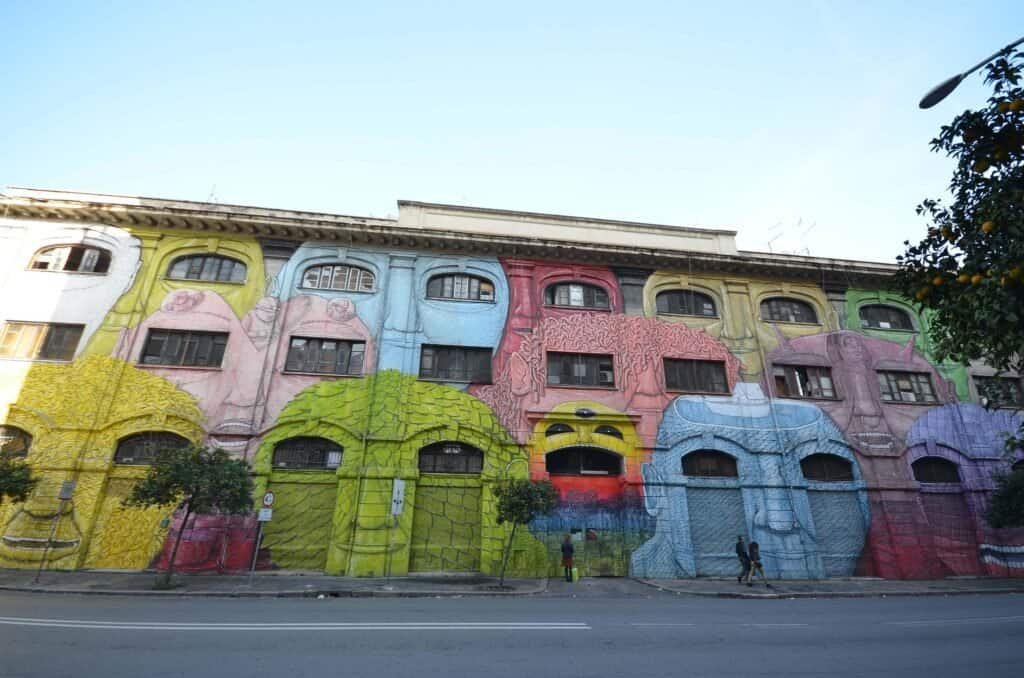
The street art around Via del Porto Fluviale is some of the best in Europe, with massive building-sized murals that you can see on a self-guided walk. The old Gasometro (gas works) is a dramatic industrial landmark.
Eataly Roma is a huge food market, full of different food stalls. Porto Fluviale is a huge restaurant in a converted warehouse and is popular with Romans rather than tourists.
Who it works for
Art and design people, anyone staying more than 3 days who wants to see something different, and people who’ve already done the historic centre on a previous visit.
Ostiense gives you a side of Rome that has nothing to do with ancient ruins or Renaissance churches (which might be appealing, or many not be).
Getting around
Ostiense has better transport links than most of the neighbourhoods on this list. Piramide metro (Line B) is at the northern end, and Garbatella metro (Line B) is further south. Both are more useful than anything in Trastevere or the centro storico. The Colosseum is three metro stops away.
Roma Ostiense train station is here too, which means the FL1 train from Fiumicino airport drops you right in the neighbourhood.
Walking to the centro storico takes 35-40 minutes, which is too far for most people to do daily. But with the metro it’s about 15 minutes to anywhere central.
Where to stay in Ostiense
On a budget: Aquas Salvias is a comfortable guesthouse with great transport links into Rome. Rooms are a bit basic but nicely decorated and comfortable. It’s a solid budget option with rooms around £100 / €115 a night (and cheaper at certain times). See pictures and more details.
Mid-range: XCross Suites Basilica San Paolo is a great guesthouse, also with excellent transport links into central Rome. Rooms are well thought out and comfortable, and most have a decent-sized balcony to sit and watch the world below from. Rooms are generally around £140 / €160, but they can be significantly cheaper at certain times. See pictures and more details.
Splurge: Ostiense doesn’t have many splurge options. You might want to consider other areas, or a whole apartment like Plant House. An apartment will give you a lot more space and is especially useful if you prefer to self-cater, but you won’t have the traditional services of a hotel. See pictures and more details.
The downsides
Ostiense doesn’t feel like “Rome” in the way most people imagine it. There are no cobbled streets or ivy-covered buildings. It’s modern, industrial, and in some areas still quite rough-looking.
It’s too far to walk to the centro storico comfortably, so you’re dependent on the metro for daily sightseeing. If you’re rushing between sites then it’s probably not the best place to stay, but if you’ve got a bit more time to explore then it’s less of a problem.
Pros: Best contemporary culture in Rome, great street art, good metro access, Centrale Montemartini, affordable
Cons: Doesn’t feel like traditional Rome, too far to walk to the centre, some rough edges, limited luxury options
Practical tips for staying in Rome
Tourist tax: Rome charges a city tax per person per night, not included in hotel prices. It varies by star rating, and is roughly €3-7/night for a 3-4 star hotel. It’s usually paid in cash at check-in.
Apartments vs hotels: On a return visit, apartments are worth considering. Look at one-bedroom places on Booking.com around the neighbourhoods above.
Booking timing: Hotel prices in Rome vary a lot by season. November to February (excluding Christmas and New Year) is cheapest. April to June and September to October are shoulder season, with decent weather and moderate prices. July and August are peak, though some hotels drop prices because it’s extremely hot and many Romans leave the city. See our guide for more information on the best time to visit Italy.
Getting around Rome: The city has 3 metro lines. Line B is the most useful for the neighbourhoods in this guide as it stops at Piramide (Testaccio/Ostiense), Circo Massimo (Aventine), Colosseo, and Termini. Trastevere has no metro so use tram 8 or bus H. The best place to stay in Rome to walk everywhere is still the centro storico, but from any of the neighbourhoods above you can reach most things within 20-30 minutes on foot or a few metro stops.
Wrapping up
The best place to stay in Rome depends on what kind of trip you’re planning. If it’s your first time and you want to be near the tourist attractions, the centro storico or Monti are still the obvious choices.
But if you don’t mind a walk or have already seen the main sights, moving away from the typical tourist areas will open up a new part of Rome. You’ll also eat better, sleep more quietly and sped far less on accommodation.
If you haven’t yet decided on what to do in Rome then see our guide to the top things to do in Rome, or our four-day itinerary to see the main sights at a slower pace. Or, see all our Italy content.
A small favour: we're trying to gather some feedback to help make our blog even better
If you have any feedback on how we can improve, please add it below. Big or small, we'd love to hear.