14 stunning places to go in Monaco (2026 travel guide)
This page contains affiliate links. If you make a purchase through one of these links we make a small commission, at no cost to you. Making a commission never affects the advice we give.
Monaco is one of those places everyone knows of, but far fewer people really know what to do with once they get there. Most people turn up expecting superyachts, sports cars and the Monte Carlo Casino, which is pretty much all we knew about Monaco. But it’s also a real country, with an old town perched on a rock, neighbourhoods that feel completely different from each other, and a layout that’s easy to get around on foot.
We visited Monaco as a day trip from Nice, which is how most people end up seeing it. That meant being choosy about what we saw: figuring out what’s worth seeing, what’s impressive just from the outside, and what you can skip without feeling like you’ve missed out. This guide is built around that mindset.
Monaco is tiny (just over 2 km²), but there’s a lot going on for such a small place: royal history, odd political arrangements, and some eye-watering levels of wealth. It’s been ruled by the Grimaldi family since 1297; it’s the world’s second smallest country after Vatican City; the most densely populated; the third richest per person; and 30% of its population are millionaires.
This guide is for anyone trying to work out whether Monaco is worth the effort, how long to spend there, and what to prioritise once you arrive. Whether you’re popping over from Nice for the day or thinking about staying longer, we’ll cover our recommendations on the best places to go in Monaco, how long you need for each, and how to avoid wasting time (or money).
Our trip
We got the bus over from Nice. It was only an hour, but the aircon was broken, so we arrived in the land of superyachts absolutely dripping (the train takes about 30 minutes and is probably better than the train, depending on where you’re staying in Nice). The walk up to the old town and the palace was the best bit, with brilliant views and a calmer side of Monaco. We loved the Casino area but others find it can be a bit soulless.
Go if
You’re already on the Riviera and fancy a nosey at how the other half live.
Don’t go if
Glitz isn’t your thing, or you’d rather spend the day somewhere with more character, like Èze or Nice’s old town.
Practical questions to plan your trip to Monaco
How long should you stay in Monaco?
Monaco might be small – just over 2 square kilometres – but there’s plenty to see and do. A day is enough for the main sights. Stay longer if you want to go inside the palace, see a show or spend time on the beach.
Most people visit Monaco for the day, which is what we did. A full day gives you enough time to see the main highlights, walk between neighbourhoods, and get a feel for the place without committing to Monaco-level accommodation prices.
If you want to go inside attractions like the Prince’s Palace or attend an evening performance, staying overnight makes sense. Monaco isn’t cheap though, so staying over might be outside of your budget – instead, you could consider staying overnight in Nice or Villefranche sur Mer and returning the next day.
Bear in mind that prices skyrocket during specific events like the Yacht Show or the Grand Prix, so plan around those dates.
Where should you stay in Monaco?
If you’re looking for five-star hotels, the Hôtel de Paris Monte-Carlo, with its iconic position on Casino Square, or the Hotel Hermitage are ideal. It would be hard to find somewhere more iconic or luxurious anyway – but, the prices are what you might expect!
If you’re like us and a night here costs what you might spend on your entire holiday, consider the charming boutique hotels or bed and breakfasts in the quieter Le Rocher area (the old town). Monaco is small so you’re never too far from anything.
Also consider staying overnight in Nice or Villefranche sur Mer (just factor in the cost of extra train travel if doing so). You’ll get far more choice.
Keep in mind that accommodation prices peak during the Grand Prix and other major events, so plan around then.
How do you get to Monaco?
Getting to Monaco is straightforward, and there are a few options depending on your starting point. Monaco doesn’t have an airport, and the closest major airport is Nice Côte d’Azur Airport. It’s about an hour away by train or bus, and departures are regular.
If you’re travelling by train, Monaco’s main station, Gare de Monaco-Monte-Carlo, is well-connected with frequent services from Nice, Cannes, and beyond. Prices are fair too.
You won’t need your passport to get into Monaco if arriving from France but it’s still worth carrying ID (especially if you plan to enter the casino).
Alternatively, there are ferry services from other parts of the French Riviera. You can also drive in, but be prepared for narrow city streets and limited parking. Train or bus is far easier.
When should you go to Monaco?
Monaco is a year-round destination, but the best time to visit depends on your interests. If you’re here for the Formula One Grand Prix or the Yacht Show, visit in May or September. During these months, the weather is pleasant, and there’s a buzz in the air with parties, events, and world-class entertainment.
If you’re not visiting specifically for these events, avoid Monaco during them – prices soar, crowds are intense, and much of the city is harder to navigate.
The late spring and early autumn months are ideal. The weather is warm but not too hot, and there are fewer crowds.
Clear days in winter can be beautiful, and Monaco’s Christmas market at Port Hercules is worth visiting. Summer brings heat and crowds, but also a great atmosphere with beach clubs, concerts, and cultural festivals.
What are the best places to go in Monaco?
Place du Casino
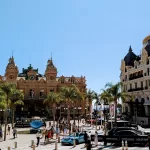
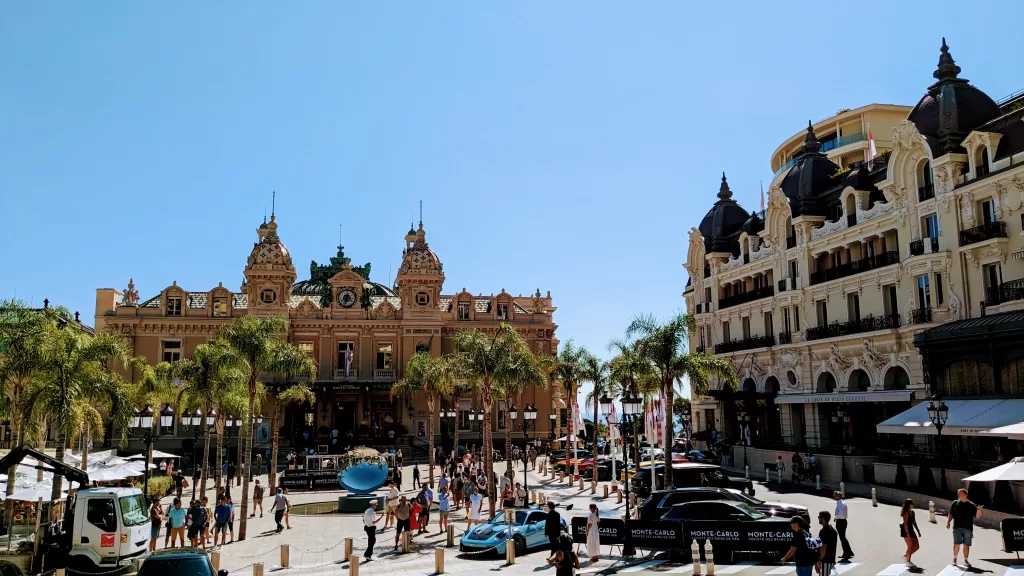
Place du Casino is the small square in Monte Carlo where the casino, the Hôtel de Paris, and the Café de Paris all sit together. If you’ve seen photos of Monaco with luxury cars parked out front and people dressed up for the evening, they were probably taken here.
The square itself isn’t big, but it’s busy almost all day, especially late morning when day-trippers arrive from Nice and again in the evening when people head to the casino and nearby restaurants.
We found it more interesting to stand back and watch for a few minutes. You’ll see expensive cars pulling up, people posing for photos, and a lot of security quietly keeping things moving. There’s a café terrace which is a great spot to have a drink and watch the comings and goings. But, it is expensive, so you can always get a takeaway coffee from elsewhere and sit on a bench or near the plant area instead.
Why go? To see Monaco’s most recognisable spot and get a feel for the place within minutes of arriving.
How long? 30–45 minutes is plenty unless you’re sitting for a drink.
Monte Carlo Casino
The Casino de Monte-Carlo is perhaps Monaco’s most famous landmark. It’s set on the Place du Casino in the centre of Monaco, and is surrounded by opulent buildings and expensive cars, and is the centre of Monaco’s glitz and glamour.
It was opened in 1863 and was built to save the Grimaldi family from bankruptcy – and create an economy based on finance, gambling and luxury. It worked, and the rest of Monaco’s development quickly followed.
You can enter the main lobby for free, which is enough for most people. To access the gaming rooms, you’ll need your passport, pay an entry fee, and follow a smart dress code. Unless you’re planning to gamble, the outside and foyer are usually enough to get the idea (it was for us).
Why go? To see Monaco’s most famous building.
How long? 30 minutes, if you’re not going for a flutter.
Monaco Opera House (the Salle Garnier)
The opera house is attached to the casino, and it’s easy to miss if you’re not looking for it. It’s small and very ornate.
It was designed by Charles Garnier, the same architect as the casino (and the Paris Opera), but on a much smaller scale. The inside looks pretty much how you’d expect: red velvet seats, gold everywhere, and some impressive frescoes.
Unless you’re seeing a performance or joining a guided tour, this is a quick stop rather than a major attraction. It’s worth stepping inside if it’s open, but you don’t need to plan your day around it unless you’re specifically interested in architecture or opera.
You can do a guided tour to learn a bit about the history and the building, or catch a show if the timing works out.
Why go? A small but lavish opera house.
How long? 1-2 hours.
The Prince’s Palace of Monaco
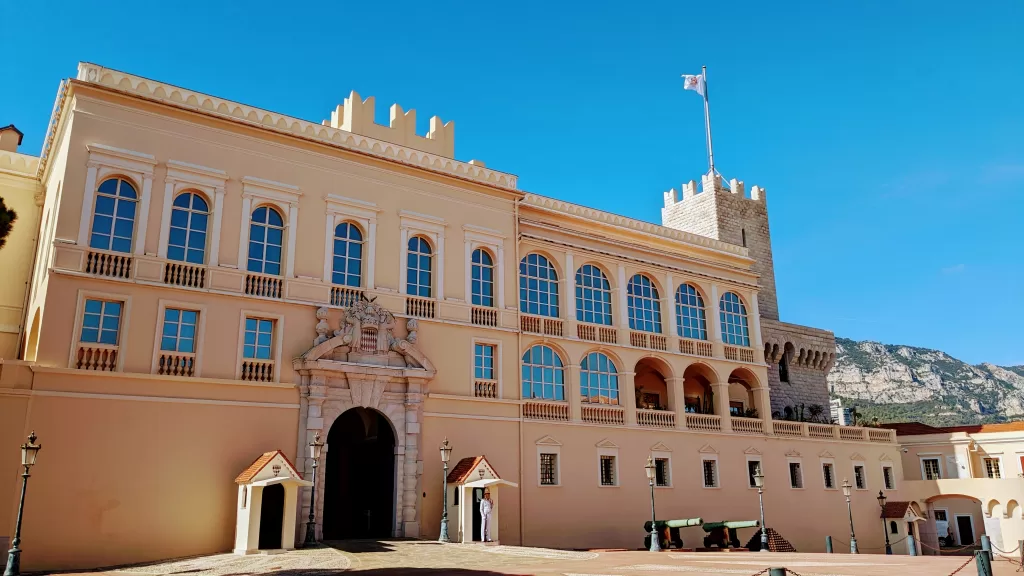
The Prince’s Palace sits up on the rock above the rest of Monaco, and walking up here is one of the best ways to see how different the old part of the country feels. It’s been home to the Grimaldi family for centuries and is still used as a residence today.
Even if you don’t go inside, it’s worth the walk. The views over the harbour are some of the best in Monaco, and the area feels calmer than Monte Carlo below. If you do want to go inside, the state apartments are open seasonally and give you a fairly traditional palace experience: grand rooms, tapestries, and lots of history.
If you’re short on time, we’d prioritise seeing the palace from the outside. You can time your visit to catch the changing of the guards, which happens daily late morning, but again this is a nice to see rather than a must-do.
It’s also near the old town, which shows another side of Monaco. You can walk from downtown Monaco (the Monte Carlo area) in about 30 minutes – which we recommend over the bus.
Why go? A historical palace and beautiful views.
How long? 1-2 hours.
Japanese Garden
The Japanese Garden is a small, tidy garden near the seafront, tucked between busy roads and modern buildings. It’s well maintained and peaceful once you’re inside, with a pond, bridge, and Japanese plants.
The garden is free to enter and open year-round. It’s a small detour from Monte Carlo so worth dropping by.
Why go? A quiet, free garden away from the traffic.
How long? 20 minutes.

The old town of Monaco – Le Rocher
Le Rocher is Monaco’s old town, and it’s where the country feels most like a place people actually live. The streets are narrower, the buildings are pastel-coloured, and everything is a bit less frenetic than down by the casino.
This is one of the best areas to just wander without a plan. You’ll pass small cafés, souvenir shops, and viewpoints looking out over the sea. It’s also where you’ll find the cathedral and the Prince’s Palace, so it naturally fits together as part of the same walk.
We’d recommend coming here earlier in the morning or later in the afternoon, when it’s quieter. It’s also a decent option for lunch, as it’s still a bit expensive but noticeably cheaper than Monte Carlo.
If you like old towns then put Belgium on your bucket list – it’s full of cobbled streets, quaint canals and medieval old towns.
Why go? Old town charm and rich history.
How long? 2 hours.

Jardin Exotique
The Jardin Exotique sits high above Monaco and is one of the best viewpoints in the country. From up here, you can see pretty much everything: the city, the port, and the coastline stretching out into France.
The garden itself is filled with cacti and succulents, which makes it feel very different from a typical European park. There’s also a cave underneath with guided tours included in the ticket, though tours run at set times.
Tickets are €7-8, depending on the season.
You can walk up (it’s steep) but bus line 2 drops you right outside, which is easier than hiking up (tickets are €2 and can be purchased on board with Contactless card). Be aware there are loads of stairs inside, so it’s not ideal if you’ve got mobility issues. Go early or later in the day to dodge the heat.
Why go? Exotic garden with stunning views.
How long? 2 hours.
Saint Nicholas Cathedral
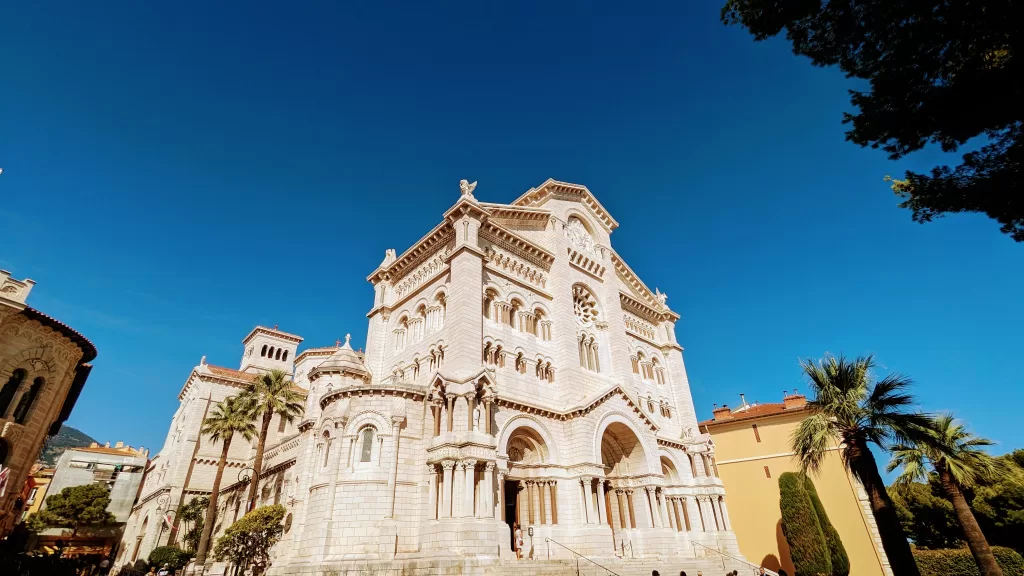
Saint Nicholas Cathedral (also called Monaco Cathedral) is worth a stop if you’re wandering around the old town. It’s where many of Monaco’s royals are buried, including Princess Grace and Prince Rainier III, so it has a bit of extra significance beyond being “just another church.”
Inside, it’s calm and fairly simple compared to some European cathedrals. You’ll see mosaics, stained glass, and a large altar, but it’s not something you need to plan around. We treated it as a short pause rather than a main attraction.
If you happen to be there during a service, the organ is impressive and worth hearing. Otherwise, this is a quick in-and-out while exploring the old town. Entry is free, so there’s no real downside to popping in if you’re nearby.
It’s open daily (usually 9am–6pm). It can get busier in the late morning, so early or late in the day is quieter if you want space to look around.
Why go? Royal history and a beautiful building.
How long? 30 minutes.
Larvotto Beach
Larvotto is Monaco’s main public beach. It’s clean, well maintained, and easy to reach, with clear water and a long promenade behind it.
The facilities are pretty modern, with showers, changing areas, and lifeguards in the summer. There are free sections where you can put down your towel, or you can rent sun loungers and umbrellas. It’s also a good spot for a walk along the seafront.
That said, if you’re only in Monaco for the day, this is one of the easiest things to skip. The beach is nice, but it’s not radically different from other Riviera beaches, and your time is probably better spent exploring parts of the country you won’t see elsewhere.
It gets packed in July and August, so if you want space, go early in the morning or later in the evening.
Bus lines 5 and 6 stop nearby (pay by Contactless on board, €2) , making it easy to reach without a car.
Why go? Beaches, sun and a break from the craziness of Monaco.
How long? 2-3 hours.

Port Hercules
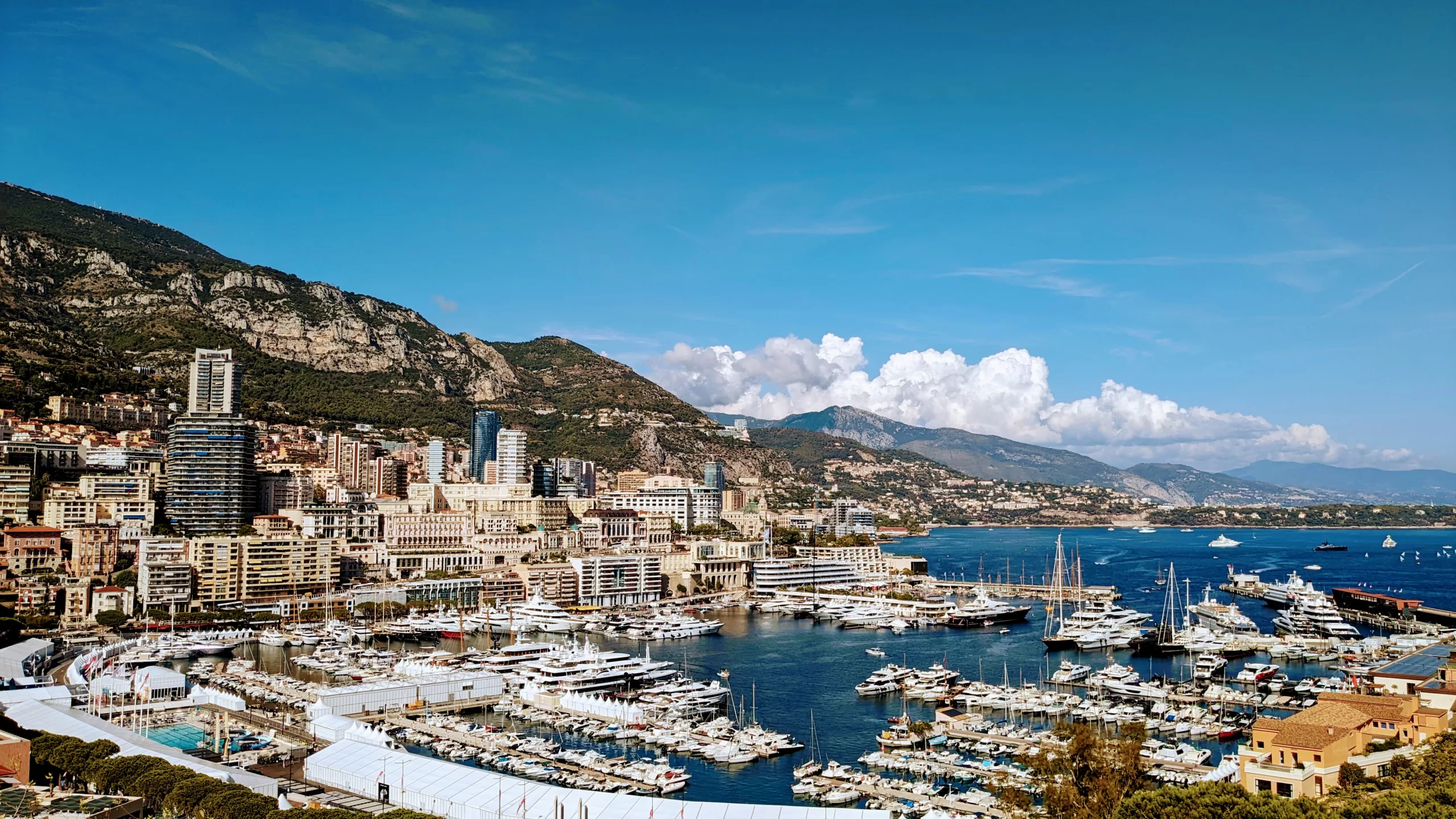
Port Hercules is Monaco’s main harbour and the place to go if you want to see ridiculous yachts up close. It’s been used since ancient times, but today it’s more about superyachts than fishing boats. Walking around the harbour doesn’t cost anything, and you can look up some of the boats to see who they belong to and how much they cost.
There are restaurants and bars along the front if you want to sit down with a drink, but the best bit is just strolling the promenade and people-watching. The Formula One track also runs along here, and in winter the port turns into Monaco’s Christmas market, so there’s usually something going on (we went as they were setting up for a huge yacht festival).
The best way to see it is on foot, ideally as part of a walk between Monte Carlo and the old town.
Why go? Luxury yachts in a pretty harbour, and to see a lot of money.
How long? 30 minutes.
Princess Grace Rose Garden
The Princess Grace Rose Garden is down in Fontvieille, away from the casino and the old town. It’s a calm, open space with over 300 rose varieties, all clearly labelled, and it feels much less touristy than most of Monaco.
It’s not as famous as the casino or the harbour, so it’s usually pretty peaceful. Spring is the best time to go, when everything’s in bloom, but it’s a nice walk any time of year. Great for a chill break if you’ve been walking around Monaco all day. It’s free to enter.
Why go? Over 300 types of rose, and it’s very peaceful.
How long? 1 hour.
Marché de la Condamine
If you want a bit of local life in Monaco, check out the Marché de la Condamine near Port Hercule. It’s the main market in town, with fresh fruit and veg, flowers, and plenty of local treats. Even if you’re not buying much, it’s a nice place to wander and soak up the atmosphere.
Morning is the best time to go, when it’s busiest and the stalls are fully stocked. Try some local snacks while you’re there, like socca (chickpea pancake) or barbajuans (fried vegetable and cheese parcels). Grab something to eat and sit on a nearby bench for a bit of people-watching, it’s a nice break from the more touristy spots.
It’s also a great and affordable stop for lunch. It’s open daily except Sunday, usually from 7am–2pm. Cash is handy for small purchases, though some stalls accept cards. It’s easy to reach on foot from the harbour or the old town.
Why go? To taste some local food.
How long? 1 hour.
Day trips from Monaco
If you’re staying longer on the Riviera, Monaco works well as part of a wider itinerary rather than a base. These nearby spots are all easy to combine with a Monaco visit:
- Èze: A medieval village perched high above the sea with incredible views and charming streets.
- Menton: Known as the “Pearl of France,” this town is famous for its gardens and colourful architecture.
- Nice: Just 30 minutes away, Nice offers beautiful beaches, museums, and vibrant nightlife.
- Cannes: Home to the famous film festival, Cannes offers glamour, luxury, and beautiful beaches.
- Saint-Jean-Cap-Ferrat: A beautiful peninsula with stunning villas and secluded beaches.
Is Monaco worth visiting?
Monaco isn’t somewhere you need weeks for, but it is somewhere that rewards a bit of planning. It works perfectly as a short stop, especially as a day trip from Nice, and it’s fascinating, slightly surreal, and different from anywhere else on the Riviera.
If you’re deciding between Riviera stops, Monaco works best as one busy day before you head somewhere slower and cheaper. If you’re already in Nice, it’s absolutely worth the detour.
If you’re planning a wider trip, you might also want to look at how Monaco compares with nearby bases like Nice or Menton, or how it fits into a longer South of France itinerary.
This article is now featured on GPSmyCity. To download this article for offline reading or travel directions to the attractions highlighted in this article, go to Walking Tours and Articles in Monaco on GPSmyCity.
Did you find what you were looking for on this page?
Please let us know what we're missing, as we'd love to improve it.