17 beautiful places to go in Marseille, France (2026 guide)
This page contains affiliate links. If you make a purchase through one of these links we make a small commission, at no cost to you. Making a commission never affects the advice we give.
Marseille isn’t your polished postcard city – it’s France’s oldest, and a little rough around the edges, city. Sun-drenched stone buildings, a working, busy Mediterranean vibe, and pretty architecture that could do with a pressure washing.
We loved Marseille, but we’ve found that it can be a Marmite city – some love it, some not so much. While it’s developed a lot in the past few years, it’s dirtier and more rundown than other cities in France. But, we loved it’s energy, lived-in beauty, and its contrast to clean and shiny Lyon which we’d just left.
In this guide, we’ll show you our favourite places to go in Marseille, from panoramic viewpoints and fishing coves to neighbourhoods bursting with street art. You’ll find practical tips on where to stay, when to go, and how to get there from the UK, plus our honest take on what to see in Marseille based on our own visit.
Marseille at a glance
- Best for: Coastal walks, street art, seafood, Mediterranean culture.
- How long to stay: 3–4 days (5–6 with day trips to the Calanques or Cassis).
- Best time to visit: May–June or September–October for warm weather without peak crowds.
- Getting there: Fly into Marseille airport, about 50 minutes from the city centre. Or take the Eurostar via Paris – see our Eurostar from London to Marseille guide. You can also get the train in, if you’re coming from elsewhere in France.
- Budget tip: Notre-Dame de la Garde, the Corniche Kennedy coastal walk, MuCEM’s outdoor areas, and Fort Saint-Jean gardens are all free.
- Average daily budget: Around £80–120 per person including mid-range accommodation, meals, and transport.
What are the best places to go in Marseille?
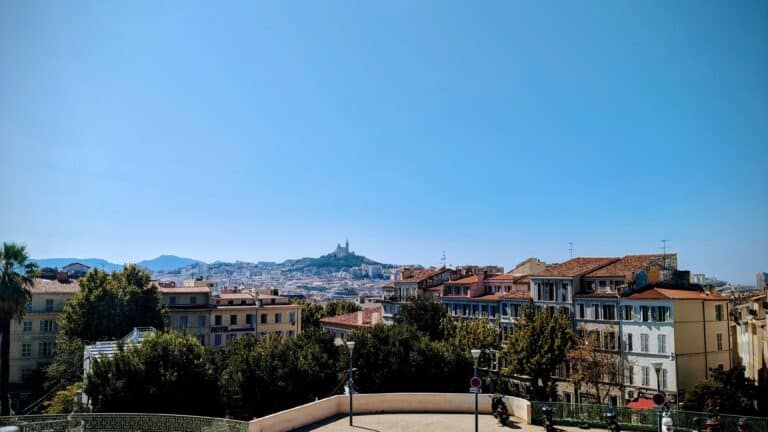
Notre-Dame de la Garde
You can’t miss this church – it’s on top of the biggest hill in the city, visible from almost anywhere. We walked up from our Airbnb one morning; when you get to roughly the bottom of the hill, it’s a steep 20–30 minutes climb, so wear trainers and bring water. There’s also a bus (bus 60 goes from the Old Port) if you’d rather skip the climb.
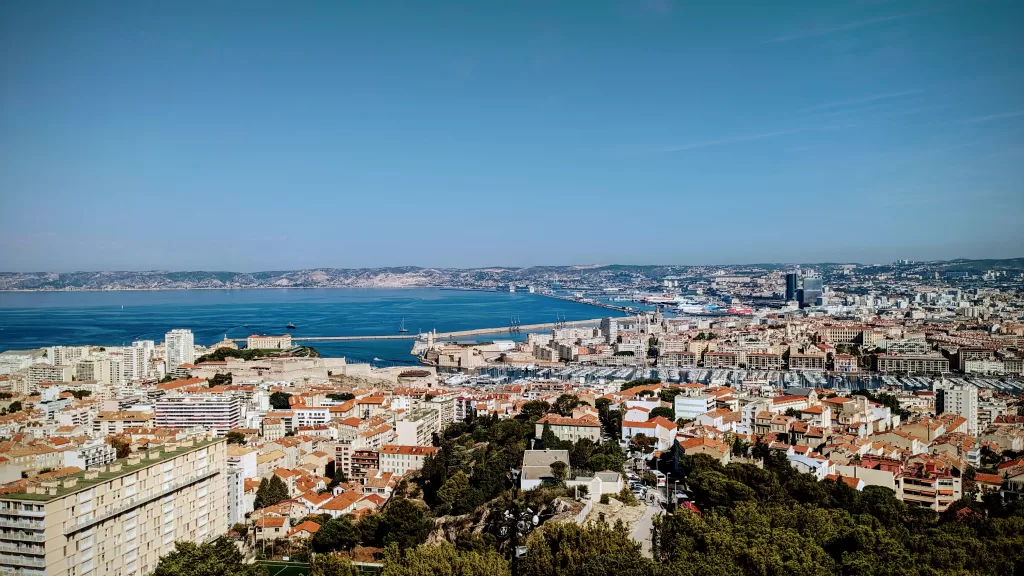
Once you reach the top, the views are unreal. You can see the entire sweep of the city, the harbour, and even the Calanques in the distance. Inside, the basilica is covered with ship models and old plaques left by sailors, which they believed would give them protection at sea.
It’s free to go in and worth doing early in the day before the crowds arrive. The gift shop has cold drinks if you forget water, and there’s a shaded area on one side to sit for a bit before heading back down.
It gets pretty busy with a lot of tour coaches, so we recommend visiting early in the morning or late afternoon to avoid the crowds.
Why go? Panoramic views of the city.
How long? 2 hours.

Le Panier Quarter
Le Panier is Marseille’s oldest neighbourhood, filled with narrow streets, colourful buildings, and various shops. It’s where the city began, back when it was a Greek colony called Massalia.
It had a completely different feel to the rest of Marseille, and we loved its quaint streets and alleys.
One of the highlights is La Vieille Charité, a 17th-century building that used to be an almshouse. Nowadays it’s home to museums, exhibitions, and a café in its peaceful courtyard. It’s worth going inside just to see the architecture – a perfect oval courtyard framed by arcades.
You’ll find plenty of small galleries, street art, and local workshops around the area, so don’t rush. Go mid-morning when it’s lively but not too hot, and stop for a coffee in one of the shaded squares.
If you want to find out a bit more about the area then it’s worth taking a walking tour. This one takes in La Panier as well as a few surrounding areas, and ends with an Aperitif in a gorgeous location.
Don’t forget to stop at a local café for a coffee or pastis, the local anise-flavoured spirit (warning: its pretty strong, so perhaps have one to share before committing to a round!).
Why go? Historic centre, street art, cultural exploration.
How long? 3 hours.
Vieux Port (Old Port)
When you arrive in Marseille, one of the first places you’ll likely find yourself is the Old Port. It’s the heart of the city, historically, socially, geographically. The port has been a trading hub since the Greek settlers founded Massalia and ever since has been central to the life of Marseille.
It’s surrounded by cafes, bars, and seafood restaurants, which are great for lunch but also drinking into the evening. It is quite touristy, so if eating you might want to go a street or two back, where prices are slightly better.
Stroll along the Quai des Belges, where you can see fishermen selling their catch at the daily fish market, or take a boat tour to explore the coastline.
Fort Saint-Jean and the MuCEM, Marseille’s huge museum dedicated to the Mediterranean, are found in the Vieux Port area. If you visit in the morning, grab a croissant and coffee at one of the port cafés – it’s one of the best people-watching spots in the city.
Also take the Ligne du Ferry boat – perhaps one of the lesser needed boat routes, but lovely nonetheless.
Why go? For the atmosphere and to eat or drink while looking over the boats.
How long? 2-3 hours.
Château d’If
If you want a little escape from the city, hop on a short ferry from the Old Port and visit Château d’If. It sits on a small island just off Marseille and was built in the 16th century as a fortress, and then became a prison. It was then immortalised by Alexandre Dumas in The Count of Monte Cristo.
Once you’re on the island, you’ll walk around the fortress walls, peek into the old cells (though they’re less dramatic than the novel version) and get really good views of the harbour and sea.
Tip: Book your ferry ahead in busy season to avoid queuing. The entrance fee is about €7 for adults, and it’s closed on Mondays. It may close in bad weather because the crossing becomes unsafe. Ferries also stop at the Frioul Islands (see entry below) – we’d recommend combining the two into a half-day trip.
Why go? Literary history, a boat trip, and more great views.
How long? 2-3 hours including the ferry crossing.
Frioul Islands (Îles du Frioul)
The Frioul archipelago sits just off the coast of Marseille and is reachable by the same ferry that goes to Château d’If – in fact, the easiest way to visit is to combine the two on a single trip. The main islands, Pomegues and Ratonneau, are connected by a small harbour and have hiking trails, rocky coves for swimming, and a wild, windswept landscape that feels miles from the city.
There are a couple of restaurants near the harbour but not much else, so bring water and snacks if you’re planning to explore. The trails are exposed and there’s very little shade, so this is best done outside peak summer heat.
We’d recommend hopping off the ferry here after visiting Château d’If, spending a couple of hours walking the trails and swimming, then catching a later ferry back to the Old Port. Check the ferry timetable before you go so you don’t get stranded.
Why go? Island escape, swimming, hiking, pair with Château d’If.
How long? 2–3 hours.
Noailles and Marché des Capucins
If you want to see a side of Marseille that most tourists miss, head to Noailles.
It’s a neighbourhood just a few minutes’ walk south of the Old Port, and is the heart of Marseille’s North African and Middle Eastern communities. It’s loud, colourful, and a bit chaotic – and it gives you a sense of the multicultural identity that makes Marseille so different from other French cities.
The Marché des Capucins is the centrepiece – an open-air market with spices, olives, fresh fruit, and street food. We wandered through it one morning and grabbed a couple of bricks (crispy pastries filled with tuna and egg) for a few euros. It felt more like a market in Tunis than one in France.
The area can feel a bit rough around the edges, and it’s busier and noisier than the tourist-friendly Old Port. But that’s part of the experience, and we never felt unsafe when we visited during the day.
Why go? Authentic multicultural atmosphere, street food, and local culture.
How long? 1–2 hours.
Calanques National Park
If you only do one thing outside the city, make it the Calanques. The Calanques are rocky inlets between Marseille and Cassis and are perfect for hiking, rock climbing, or just relaxing by the sea. They’re like something out of another world, with steep limestone cliffs, turquoise water, and hidden coves you reach either on foot or by boat.
You can hike to spots like Sormiou or En-Vau if you’re up for a challenge, or take a boat tour if you’d rather sit back and enjoy the view. Either way, it’s spectacular. Just be aware that in summer some trails close due to fire risk, so always check before you go.
The best months are spring and early autumn when it’s warm but not scorching. Take plenty of water and wear proper shoes.
Getting there via public transport is possible but a bit convoluted, so do your research first. Or, consider an organised tour.
Why go? Natural beauty, hiking, water activities.
How long? Half-day to full day.

Cours Julien
Cours Julien was one of our favourite areas to spend time in, especially in the evenings. It’s Marseille’s bohemian quarter and is less polished than the Old Port area, with record shops, vintage stores, and bars spilling onto the pavement. We ended up here most nights for drinks and found it had a completely different energy to the rest of the city.
During the day, the area is full of small independent shops selling everything from vintage clothes to handmade jewellery, and there are murals on almost every building – it’s one of the best areas for street art in the city. We found Sunday mornings were quieter and better for photos before the crowds rolled in.
In the evenings, the bars come alive and you can sit outside with a cold beer and watch the neighbourhood do its thing. There’s often live music too. If you want to explore further, the nearby La Belle de Mai area has a more industrial, alternative feel with studios and creative spaces tucked into old warehouses.
Why go? Street art, nightlife, shopping.
How long? 2-3 hours.
Abbaye Saint-Victor
One of the oldest religious buildings in France, the Abbaye Saint-Victor dates back to the 5th century and sits on the south side of the Old Port. It’s one of the oldest religious buildings in France.
From the outside, it looks more like a fortress than a church – it was fortified in the 14th century and the thick stone walls give it a very different feel to the ornate cathedrals elsewhere in the city.
Inside, the highlight is the crypt, which contains early Christian sarcophagi and is one of the most atmospheric underground spaces we’ve visited. It costs a few euros to enter the crypt, but the church itself is free.
It’s an easy addition if you’re walking along the Corniche or exploring the area south of the port, and it’s just around the corner from the Four des Navettes bakery (which has been making traditional navette biscuits since 1781 – worth a stop).
Why go? Ancient history, atmospheric crypt, off the main tourist trail.
How long? 30–45 minutes.

Marseille Cathedral (Cathédrale de la Major)
The Cathedral of La Major is nothing like the Gothic cathedrals you see in northern France. The striped stonework and Byzantine-style domes make it feel more Mediterranean than French, and it’s absolutely massive up close. It was built between 1852 and 1893, partly to show Marseille’s power and ambition at the time.
We visited after exploring Le Panier – it’s a short walk downhill from the neighbourhood. Outside, there’s a large terrace with sea views and views across to the Old Port, which is a nice spot to sit for a few minutes. Inside, the mosaics are worth seeing and the crypt contains the remains of several bishops. Entry is free.
It sits just across from MuCEM, so it’s easy to combine the two. If you walk a few minutes further downhill, you’ll reach Les Terrasses du Port – a shopping mall with an outdoor deck overlooking the harbour, which is a decent coffee stop.
Parc Borély
If you need a break from stone buildings and busy streets, Parc Borély is Marseille’s best green space. It’s a large park about 4km south of the Old Port, centred around an 18th-century château that now houses the Museum of Decorative Arts.
The park has a botanical garden, a lake with rowing boats, and wide tree-lined paths that are popular with joggers and families. It’s a calm contrast to the rest of the city and a good spot for a picnic if the weather’s nice (there’s shops nearby to pick up a few bits). We walked here from the Corniche Kennedy and it was a nice break.
It’s easy to reach by bus (lines 19 or 83 from the Old Port area), or you can walk along the coast from the Corniche (see the next entry below), which takes about 40 minutes and passes several small beaches on the way.
Why go? Green space, a botanical garden, and peaceful escape from the city.
How long? 1–2 hours.
Why go? Architectural marvel, historical landmark, photography.
How long? 1-2 hours.
Corniche Kennedy and Vallon des Auffes
The walk along the Corniche Kennedy was one of the highlights of our trip. It runs along the coast for about 5km, with the sea crashing below and locals jogging, cycling, and fishing along the way.
We walked it late afternoon and the light was stunning. It’s free, there’s no queue, and it’s one of the best things to do in Marseille without spending a penny.
About halfway along, you’ll spot Vallon des Auffes tucked below the road – a tiny fishing port centred around a small cove, with colourful boats, fishermen’s houses, and a handful of restaurants. It felt like stepping into a different village entirely. We stopped for lunch here and it was one of our favourite meals of the trip – try bouillabaisse (Marseille’s signature fish stew).
The views of the Sainte Marie Lighthouse and the coastline are particularly good at sunset. It’s small and you won’t need long, but the coastal walk to get there is half the fun. Follow the route on Google Maps from the Old Port.
Why go? Authentic atmosphere, seafood, and a picturesque setting
How long? 1-2 hours

Palais Longchamp & Parc Longchamp
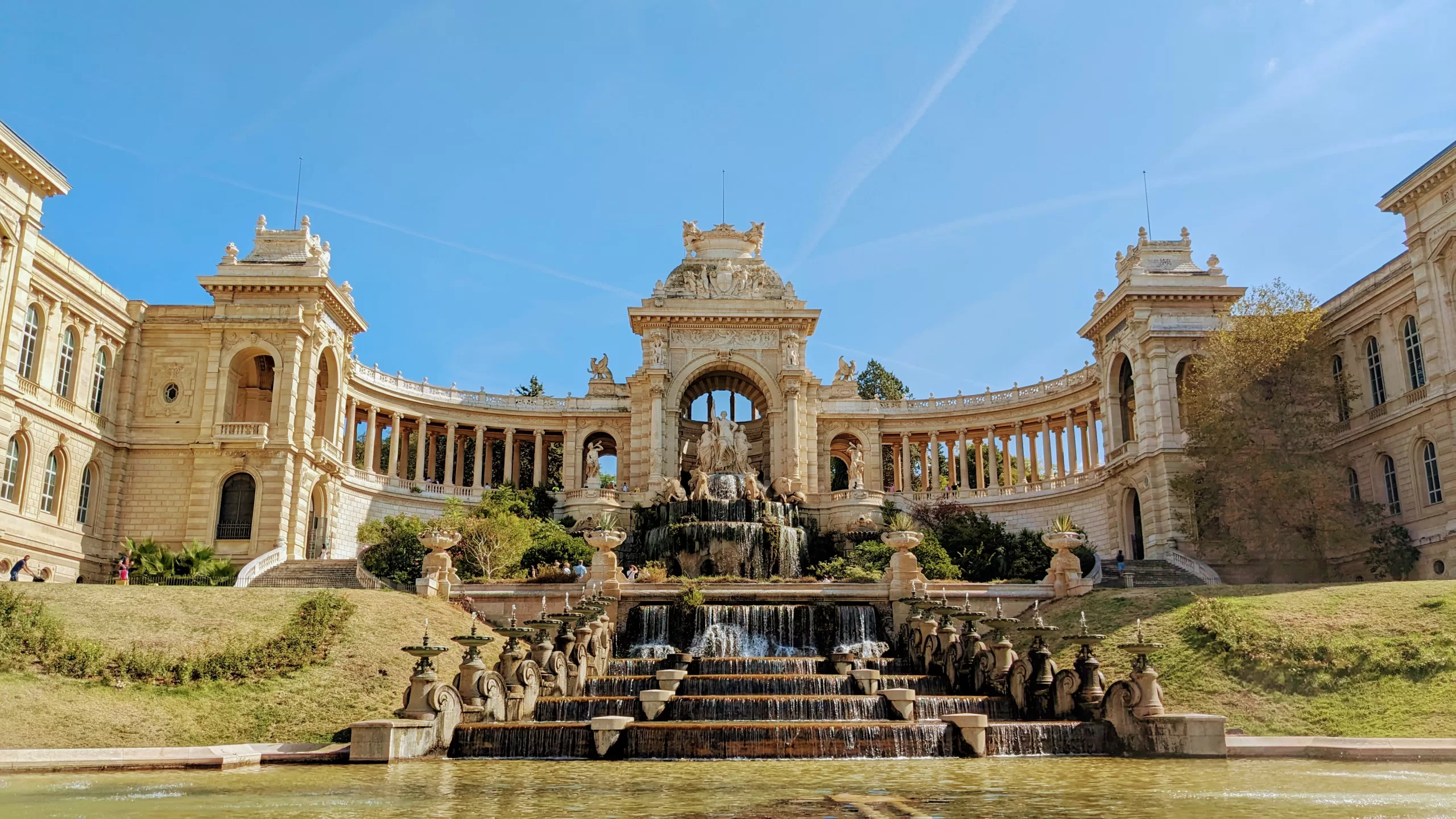
The Palais Longchamp is one of Marseille’s most beautiful buildings and houses the city’s Natural History Museum and Museum of Fine Arts.
It was built to celebrate the canal that finally brought water to the city, and the fountains and columns make it feel like a mini Versailles. The two wings house art and natural history museums, but the real joy is just walking around the grounds.
Wander round the ornate fountains, or explore the museums. Behind it is Parc Longchamp, a green space with the remains of the zoo scattered throughout. We found it to be a bit rundown when we visited, but it’s worth a quick wander around.
It’s a calm contrast to the busy city centre, and the view down the avenue from the steps of the palace is one of the prettiest in town. You can reach Palais Longchamp easily by metro (Line 1, stop Cinq Avenues Longchamp), or walk.
Why go? Museums, picturesque park, architectural beauty
How long? 20 minutes if seeing just Palais Longchamp, but 2-3 hours if going to the museums
MuCEM (Museum of European and Mediterranean Civilisations)
If you want culture with views, go to MuCEM, the Museum of European and Mediterranean Civilisations.
The MuCEM is Marseille’s newest national museum and an icon of modern Marseille. It sits at the entrance to the Vieux Port and is dedicated to the history and culture of the Mediterranean. It’s not just “old stuff from the past” but it also reflects migration, contemporary issues, and the sea-facing identity of Marseille.
It includes exhibits on everything from ancient civilisations to contemporary art, featuring works by Andy Warhol and Jean-Michel Basquiat.
The architecture itself is something you’ll remember: the J4 building juts out into the sea, the mesh of concrete walls casts interesting shadows, and there’s a footbridge linking the museum to the historic Fort Saint-Jean.
The museum is closed Tuesdays. Adult tickets for the exhibitions are €9.50. If you’re on a budget but still want the architecture and views, you can walk around the outdoor areas and the fort gardens (which are free) and still get a lot out of it.
Head to the rooftop terrace for one of the best panoramic views in the city. It’s a nice area to wander round too, as it also contains Fort Saint-Jean which dates back to the 12th century.
Why go? Cultural exploration, contemporary art, panoramic views
How long? 2-3 hours
Day trips from Marseille
If you have more than three days in Marseille, these day trips are all within easy reach and worth adding to your itinerary. We book regional train and bus tickets through Omio, which compares prices across providers.
Cassis (30 minutes by train, €7–8 return): A pretty coastal town known for its cliffs, pastel-coloured harbour, and calanques. It’s a more relaxed base for boat trips to the calanques than Marseille, and the local white and rosé wines are worth trying.
Aix-en-Provence (35 minutes by train, €9–12 return): A classic Provençal city with tree-lined boulevards, excellent markets, and the atelier of painter Paul Cézanne. It’s more polished than Marseille – a good contrast if you want a change of pace.
Avignon (1 hour by TGV, €15–25 return): Visit the enormous Palais des Papes, walk across the famous Pont d’Avignon, and explore the walled old town. Easily doable as a day trip.
Les Baux-de-Provence (harder to reach without a car, around 1h15 by bus via Arles): A dramatic medieval village perched on a limestone ridge with panoramic views across the Alpilles. The Carrières de Lumières immersive art show in the old quarries nearby is excellent.
Cassis Calanques hiking: If you’ve already done a boat trip from Marseille, consider hiking the calanques from the Cassis side instead. The route from Port Miou to Calanque d’En Vau takes about 4 hours round trip and the final cove is spectacular, though the trail is steep and rocky in places.
Practical tips for visiting Marseille
How long should you stay in Marseille?
A minimum stay of three to four days in Marseille is ideal. This gives you long enough to explore the main attractions like the Notre-Dame de la Garde, the Vieux Port, and Le Panier Quarter while not feeling too rushed and with enough time to wander round some of it’s neighbourhoods.
If you’re planning day trips to nearby spots like the Calanques National Park or Cassis, consider extending your stay to five or six days.
Marseille has a lot to offer, and while a shorter visit will cover the basics, a few extra days will help you appreciate it.
If you’re short on time, two full days can still work – focus on Le Panier, the Vieux Port, and a sunset visit to Notre-Dame de la Garde.
Where should you stay in Marseille?
Choosing where to stay in Marseille really depends on the vibe you want – each neighbourhood has its own rhythm.
If you want to stay in the heart of Marseille, the Vieux Port area is the best choice. This area is full of life, with easy access to restaurants, bars, and major attractions like the Notre-Dame de la Garde and the Quai des Belges. We stayed a few streets back from it, near Estrangin metro station, which was perfect for us. We found our apartment on Booking.com and paid around £90 a night for a one-bed flat with a small kitchen – great for keeping costs down by making breakfast at home.
Also consider staying in Le Panier Quarter, Marseille’s oldest neighbourhood. The neighbourhood has a lot of character and it’s full of quaint guest houses on narrow streets.
Alternatively, the lively Cours Julien area, known for its street art and vibrant atmosphere, has a more bohemian vibe and has plenty of bars and restaurants.
Or, for somewhere quieter, check out Endoume or Les Goudes. Both have a more local feel and easy access to the coast.
How do you get to Marseille?
Marseille is well-connected by air, rail, and road.
The Marseille Provence Airport has regular flights from the UK and beyond, including with the budget airlines. We use Kiwi.com to compare prices across Ryanair, easyJet, and the other budget airlines – it’s the quickest way to find the cheapest route from your nearest airport. Trip.com is also worth checking, especially for last-minute deals.
From the airport, it’s about 30 minutes by bus or taxi from the city centre (take the 91 bus to Marseille Saint Charles train station. You can buy tickets online or at the airport). If you’re landing late, note that the airport bus doesn’t run 24 hours so you might want to book a transfer ahead of time. We use Welcome Pickups as we’ve always found them the cheapest and most reliable.
Marseille’s Saint-Charles train station has direct TGV connections to Paris (3h15), Lyon (1h40), and Nice (2h30), as well as international routes to cities in Italy and Spain. We book European train tickets through Omio, which compares prices across TGV, Eurostar connections, and regional services – it saved us a fair bit when we travelled down from Lyon.
If you’d rather skip the flight entirely, you can take the Eurostar from London to Marseille via Paris or Lille. The total journey takes around 6–7 hours, and it’s a great option if you want to travel more sustainably. We’ve written a full step-by-step guide to taking the Eurostar from London to Marseille, including costs, timings, and how to book.
Once you arrive, the best way to explore the city is on foot – most of the main attractions are within walking distance of each other. For longer distances, Marseille has a decent public transport system with two metro lines, three tram lines, and a bus network. A single ticket costs €2 and is valid for one hour across all modes. If you’re staying a few days, pick up a 72-hour pass (€12.50) from any metro station. Uber is also available and tends to be cheaper than taxis.
One more thing: if your flight to Marseille is delayed by more than 3 hours or cancelled, you could be owed up to £520 in compensation under EU rules. We use Airhelp to handle claims – they take care of all the paperwork and you only pay if you win. You’ll get more if you claim directly, but it’s a lot less worth and we think worth the cost.
When should you go to Marseille?
The best time to visit Marseille is from May to October, when the weather is warm and sunny, perfect for exploring the city and enjoying the Mediterranean coastline.
July and August are the peak tourist months and they become pretty busy, and with higher prices.
If you prefer it to be a bit quieter, consider visiting in May, June, September, or October, when the weather is still pleasant but the city is less crowded.
Winter can be a quieter time to visit, and while the temperatures are cooler, it’s still mild compared to a lot of Europe. Marseille’s attractions and museums will be a lot quieter, but you might find some attractions, like boat tours to the Calanques, have limited availability.
Is Marseille safe for tourists?
Marseille has a reputation for being rough, and we’d heard mixed things before visiting. In our experience, the main tourist areas – the Vieux Port, Le Panier, Notre-Dame de la Garde, and the Corniche – all felt safe during the day and into the evening. We walked around at night without any issues, though we stuck to well-lit, busier streets as we would in any big city.
The drug-related violence you occasionally see in the news is almost entirely concentrated in the northern suburbs, well away from anywhere a tourist would go. That said, pickpocketing is a risk in crowded areas like the Old Port and on public transport, so keep your belongings close and don’t leave your phone on a café table.
Marseille felt no less safe than other large European cities we’ve visited. Use common sense and you’ll be fine.
What to eat in Marseille
Marseille’s food scene is one of the best things about the city, and it goes well beyond the seafood restaurants around the Old Port. The dish you’ll see everywhere is bouillabaisse, a rich fish stew that originated here – we tried it at Vallon des Auffes and it was one of the best meals of the trip, though expect to pay €25–40 per person at a decent restaurant.
Pastis is the local drink – an anise-flavoured spirit you mix with water. You’ll see it on every bar menu and it’s practically a symbol of the city. We’d recommend trying it once (it’s strong, so share one before committing to a round).
For something different, head to the Noailles neighbourhood, sometimes called the “belly of Marseille”. The Marché des Capucins is packed with spices, fresh produce, and North African street food – it’s a reflection of Marseille’s huge Algerian, Tunisian, and Moroccan communities and gives the city a flavour you won’t find anywhere else in France. Pick up a panisse (a chickpea fritter) or a brick (a crispy pastry filled with tuna and egg) from one of the stalls.
Also look out for navettes, boat-shaped biscuits flavoured with orange blossom that are a Marseille specialty. The Four des Navettes bakery near Abbaye Saint-Victor has been making them since 1781.
Frequently asked questions
Where next?
Marseille might be rough around the edges, but we loved it’s culture.
Between its fishing coves, chaotic street art, and sunsets over the Old Port, there’s a lot to do whether you’re here for a weekend or a week.
🥐 Read our guide on all the best places to visit in the South of France
🥐 Getting here by train? Read our Eurostar from London to Marseille guide
🥐 If you need a car as part of a French road trip, see our guide to the best car hire companies in Marseille
🥐 Or check out all our content on travelling to France.
This article is now featured on GPSmyCity. To download this article for offline reading or travel directions to the attractions highlighted in this article, go to Walking Tours and Articles in Marseille on GPSmyCity.
Did you find what you were looking for on this page?
Please let us know what we're missing, as we'd love to improve it.