16 best things to do in Brussels, Belgium (2026 travel guide)
This page contains affiliate links. If you make a purchase through one of these links we make a small commission to help run this site, at no cost to you. Making a commission never affects the advice we give - see our content policy.
Brussels is the capital of Belgium and the de facto capital of the European Union. It sometimes gets a bad rap as not having as much character as other places in Belgium, but we disagree – it’s definitely worth a visit and we found plenty of things to do in Brussels!
This guide pulls together the best bits: the obvious show-stoppers like the Grand Place and the Atomium, plus the stuff you’d probably miss if you were just following a guidebook – a comic-strip mural tucked down a quiet alley, a local market that isn’t just for tourists, and a centuries old pub with some amazing Belgian beer.
Whether you’re here for a weekend city break from the UK or just passing through on the way to Bruges or Ghent, these are the stops that gave us a proper feel for the city – and they’ll do the same for you.
What are the best things to do in Brussels?
Wander round the historic city centre
Whenever we visit a new city, a highlight for us is wandering around beautiful streets surrounded by interesting architecture. While it doesn’t have the small town feel of Bruges, its historic centre is beautiful and one of the best things about Brussels. Yes, it’s full of tourists, but it still feels like a real, lived-in city.
You can of course take a free or paid walking tour, but we prefer self-guided tours. We’ve featured a few highlights in this post, and we’d also recommend:
- Wandering through the Galeries Royales Saint-Hubert, a beautiful glass-covered arcade lined with upscale shops and cafes.
- Getting lost in the quirky antique shops of Marolles, or exploring the bars and restaurants in the Dansaert district.
- Stopping at Place du Grand Sablon, an elegant square lined with upmarket chocolate shops, antique dealers, and café terraces. It’s quieter than the Grand Place and a good spot for a coffee break. On weekends there’s a small antiques market too.
- Spotting the street art dotted around Brussels. We’d recommend looking up any temporary art installations too – there’s normally something going on.
- Keeping an eye out for Brussels’ Art Nouveau architecture. The city has some of the best examples in Europe, largely thanks to architect Victor Horta. His townhouses (including the Horta Museum in Saint-Gilles) are UNESCO-listed, but you’ll spot Art Nouveau flourishes on buildings across the centre too – decorative ironwork, curved glass, and organic stonework on otherwise ordinary facades.
- Hunting for hidden treasures and soaking up the atmosphere at Marollès Flea Market (weekends only, best early morning).
- Dropping into the Eglise Saint-Nicolas. Look up high, and you’ll notice a cannon ball embedded into the wall of the left nave from the French bombardment of 1695.
- Seeing the Mont des Arts, a small area on a hill with some beautiful gardens and great architecture.
While at the Mont des Arts, look out for the Musical Instruments Museum (MIM) – it’s housed in a stunning Art Nouveau building and has a rooftop restaurant with panoramic views over the city. Even if you’re not interested in the instrument collection, the building and the views make it worth a stop.
Why go? Pretty streets and beautiful architecture. But mainly because it’s a great way to see Brussels and orientate yourself to the city.
How long? One day, including stops at a few attractions.

People watch at the Grand Place
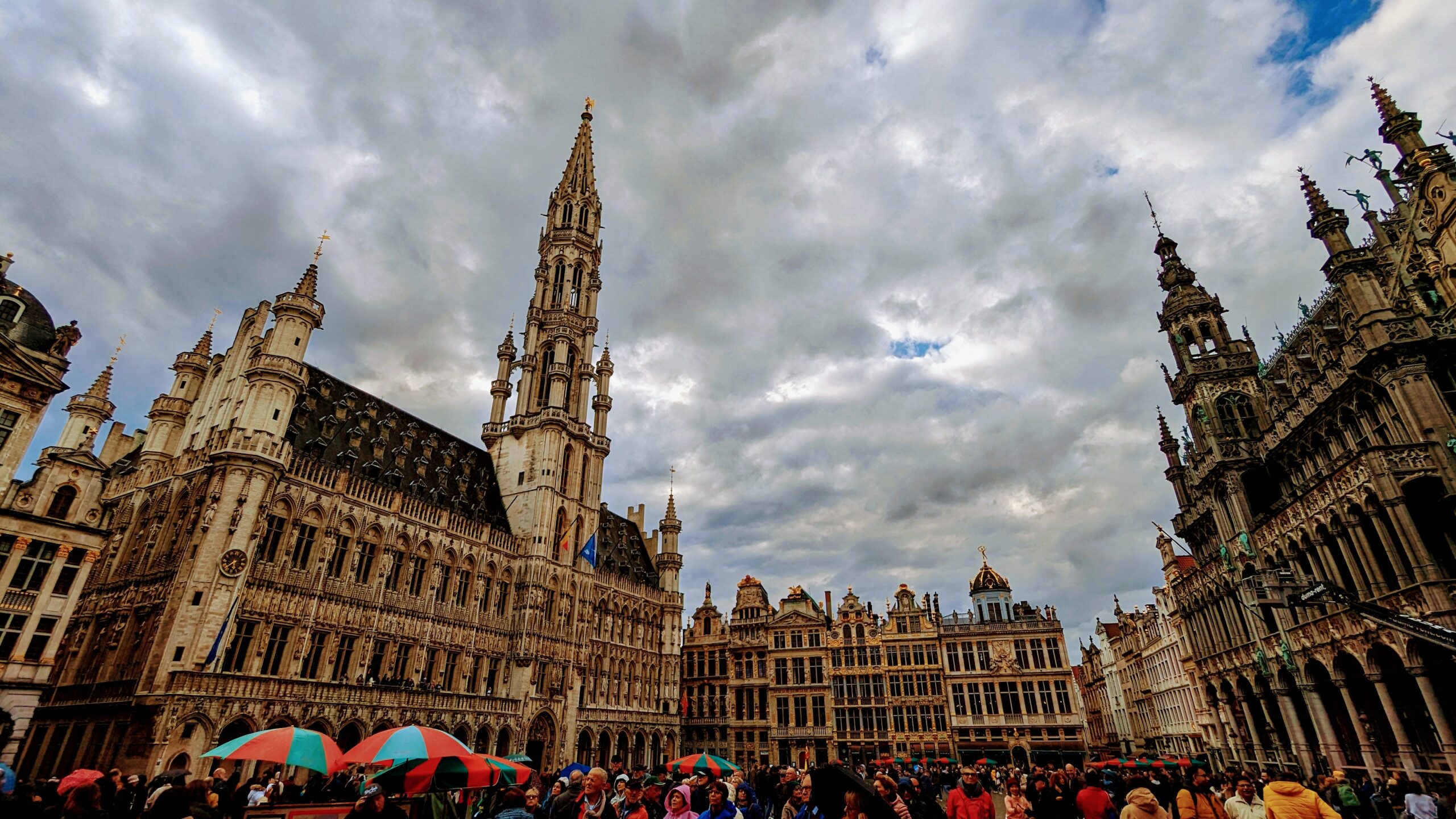
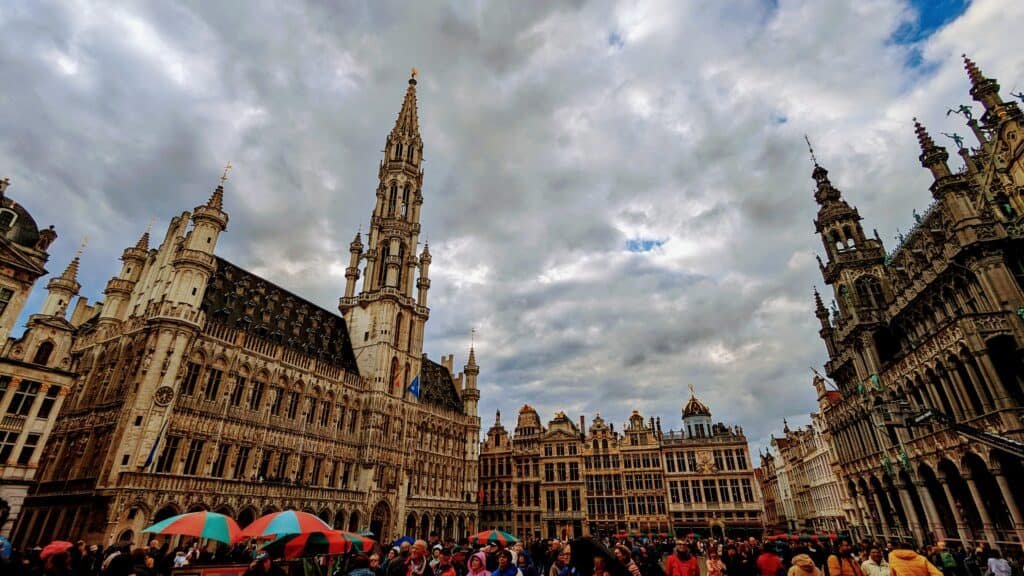
The Grand Place is the main square in Brussels and the most popular tourist attraction in the city (and a UNESCO world heritage site). It dates to the 12th century and has been an important market square for centuries.
It’s surrounded by beautiful medieval guildhalls and guild houses, built between the 15th and 17th centuries in Gothic, Baroque and Louis XIV styles. Each one was once home to a different guild, but now the buildings have mainly been taken over by a range of different restaurants and bars. It also has the Hotel de Ville de Bruxells – Brussels’ 15th Century town hall – and the City Museum (Maison du Roi).
Today, the Grand Place is the heart of downtown Brussels. It’s a great place to admire the architecture, people watch, and eat and drink at the many restaurants and cafes (though you may want to go back a block or two if you want somewhere quieter or cheaper). In summer, there are flower markets and music festivals held in the square. It’s the perfect place to sit at an outdoor cafe, relax and soak up the lively atmosphere.
It’s worth going during the day to see it and wander round, but don’t forget to come back at night when the whole square is beautifully illuminated. Every two years (even years) the square is covered in a spectacular Flower Carpet – if your trip coincides with mid-August in an even year, it looks amazing.
Just off the square, the old Bourse building is now home to Belgian Beer World, an interactive museum covering Belgian brewing history. We didn’t visit on this trip but it’s been getting good reviews and is on our list for next time.
How long? About 30 minutes to wander about and read up on some of the history. Longer if you want to stop at any of the shops, attractions or restaurants.
Why go? Beautiful architecture, medieval buildings, and the hustle and bustle.
Climb the Atomium
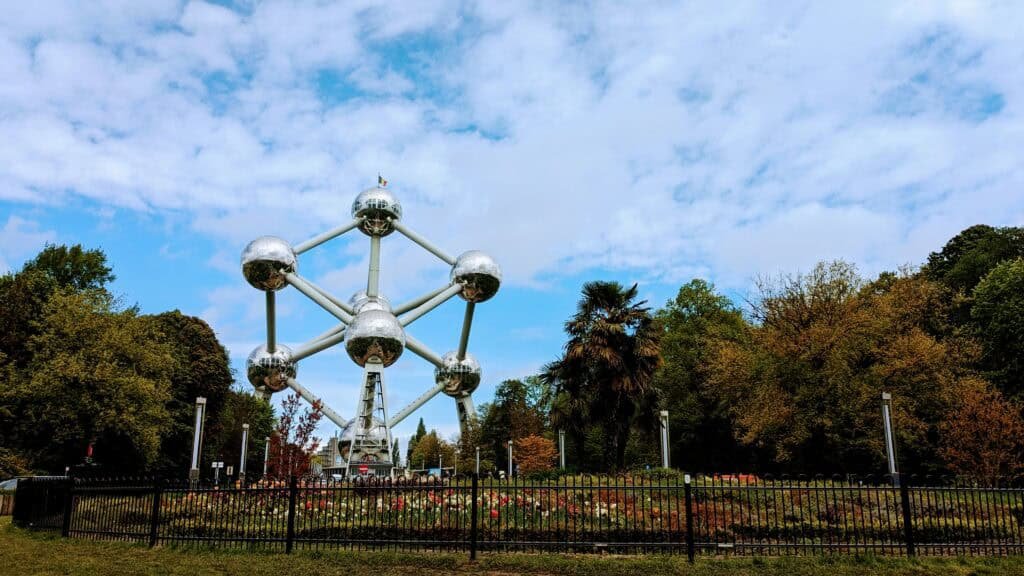
The Atomium is one of Brussels’ most iconic landmarks and a must-see for first time visitors. It’s controversial – some people love it while others hate it – but we liked it! It was one of our favourite things to do in Brussels, but its maybe not for everyone.
This futuristic structure was originally built for the 1958 Brussels World’s Fair and resembles an iron crystal magnified 165 billion times. There are nine polished aluminium spheres, all of them connected and most of them open to tourists. You’ll start by going through an exhibition covering world fairs and the design of the Atomium. You then move through some light shows – which were pretty cool – before going onto a sphere containing temporary exhibitions (when we were there it contained a photo exhibition of different world fair sites).
You’ll finish by taking the lift up to the top sphere where you’ll get amazing views across Brussels. When we went, there was a queue to for the lift of about 25 minutes, but it was worth the wait. This sphere also contains a restaurant and bar, perfect for a brief stop or some lunch.
The Atomium is particularly impressive when lit up at night, and has become an internationally recognized symbol of Brussels. It’s located in the Heysel district, a short metro ride from the city centre (we walked, which took us about an hour).
Tickets cost €17 (in March 2026) which gives you access to the Atomium plus the ADAM – Brussels Design Museum across the road. There were queues to buy tickets and then to enter when we went in the morning. We’d recommend buying tickets online the day before to skip the queues, and also visiting around lunchtime – it was a lot quieter when we left.
How long? 1.5 hours once inside the Atomium. More if you’re stopping at the bar/restaurant and more if you go onto the design museum.
Why go? Beautiful views, an interesting and different attraction, and we now know a lot more about world fairs!
Explore the European Quarter
Brussels is one of the three capitals of the EU, and its well worth having a wander round the European Quarter. Nestled in the city’s east side, think sleek, modern buildings, interspersed with hidden green spaces and a surprising amount of history.
In particular, we’d recommend going to:
- The Berlaymont: This iconic cruciform building is the headquarters of the European Commission, the executive branch of the EU. Guided tours are occasionally offered, so check their website
- The European Parliament (Hemicycle): the main debating chamber where EU representatives vote on legislation. You can book a free visitor session to observe a session live. Next door, the Parlamentarium is a free, interactive visitor centre that explains how the EU works – it’s well done and one of the best free things to do in Brussels.
- Council of the European Union (Europa Building): This imposing structure houses the Council, where representatives of EU member states meet to discuss and approve legislation. While you can’t wander the halls of power, it’s still an impressive sight.
- Schuman Square: This central square is the heart of the European Quarter, named after Robert Schuman, one of the founding fathers of the EU. Take a seat at a cafe and watch the world of European politics go by.
- Espace Léopold: This charming district, originally built in the 1830s, offers a glimpse into Brussels’ pre-EU past. Explore the elegant townhouses and leafy squares, a contrast to the modern architecture of the EU institutions.
- European Commission Library: This architectural gem houses a vast collection of books and documents related to the European Union. Even if you’re not a bookworm, the building itself, with its impressive atrium and rooftop terrace, is worth seeing.
After a day exploring, head to the lively bars and restaurants around Place Luxembourg for a taste of Brussels’ international atmosphere.
Why go? Interesting buildings, history, and another side to Brussels
How long? Two hours to wander round
Visit the Cathedral of St. Michael and St. Gudula
The Cathedral of St. Michael and St. Gudula is Brussels’ primary church and one of the best Gothic buildings in Belgium. It was built over several centuries (from the 11th to the 15th century) and has been the site of royal weddings and state funerals.
We popped in while walking between the Grand Place and the European Quarter – it’s right on the route and free to enter. The interior is impressive (from the 16th century, apparently). There’s also a small crypt and treasury you can visit for a few euros.
Why go? Stunning Gothic architecture and it’s free – an easy stop between the centre and the European Quarter.
How long? 20–30 minutes.
Find the Manneken Pis
The Manneken Pis is one of Brussels’ most famous landmarks. It’s a small 55.5 cm bronze fountain sculpture depicting a naked little boy urinating into the fountain’s basin.
The statue dates back to the 17th century, though its origins are a bit murky. According to one legend, a young boy named Julianske saved the city by extinguishing a fuse to a bomb with his urine. The grateful residents erected the fountain in his honour. Another tale says it was built to commemorate a lost nobleman’s son. The little boy is dressed in various costumes throughout the year, and now has over 900 outfits his wardrobe.
We won’t lie – when we visited it felt like one of those attractions which is visited because its famous. It’s a nice statue and worth seeing, but there’s not too much to it. There’s a nice restaurant (Poechenellekelder) next to it with a pretty whacky interior and relaxed outdoor tables, perfect for sipping on one of the 50 or so Belgian beers they offer.
There’s also two other ‘pis’ statues to find – Jeanneke Pis (little girl) is a small fountain near Delirum Café and Het Zinneke, which is a small statue of a dog (also peeing, but this one isn’t a fountain).
How long? 10 minutes
Why go? It’s cute, you’ll probably stroll past it anyway, and you can tick it off the must-see list.
Get cultured at the Royal Museums of Fine Arts
The Royal Museums of Fine Arts (Musées Royaux des Beaux-Arts de Belgique) comprise two prestigious art museums housed in an elegant 19th-century building: the Museum of Ancient Art and the Museum of Modern Art. Together, they hold an extensive collection of paintings, drawings, and sculptures spanning several centuries.
The Museum of Ancient Art exhibits works from the 15th to 18th centuries, including an exceptional collection of Flemish Primitive and Renaissance art. Major highlights include masterpieces by Peter Paul Rubens, such as his world-famous ‘The Ascent to Calvary’, as well as iconic works by Anthony van Dyck, Pieter Bruegel the Elder, and Jan van Eyck. There’s also Van Eyck’s renowned ‘Adoration of the Mystic Lamb’, a stunning 15th-century altarpiece better known for its home in Ghent.
The Museum of Modern Art focuses on 19th and 20th century art, including an impressive array of Belgian art along with works by French, Dutch, and German artists. Key pieces include canvases by James Ensor, Fernand Khnopff, and René Magritte.
Next door, the Magritte Museum is dedicated entirely to the Belgian surrealist and houses over 200 of his works across three floors. We didn’t go inside on this trip (two days wasn’t enough to do every museum properly), but if surrealist art is your thing, it’s one of the most popular museums in Brussels and well worth setting aside a couple of hours for. Entry is separate from the Royal Museums – tickets cost around €10.
Why go? Beautiful art housed in some cool buildings
How long? Two hours per museum, depending on how much you like your art.
Walk round the Parc du Cinquantenaire
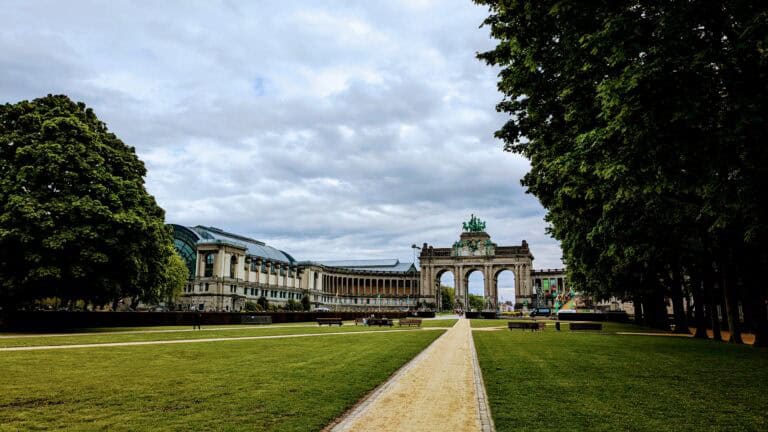
Parc du Cinquantenaire is an impressive public park located in the European Quarter of Brussels. The park features monuments, museums, and architecture dating back to the late 1800s.
The park was built in 1880 to commemorate the 50th anniversary of Belgian independence. It’s a nice place for a stroll with its tree-lined pathways and green spaces, but it’s the Triumphal Arch, an iconic monument with three arched gateways overlooking the park, which really makes a visit worth it. When we visited there was a bar to the right of the arch with great views over the park.
Some of Brussels’ best museums are located within the Cinquantenaire complex, including The Royal Museum of Art and History, which houses an extensive collection of art, artefacts; the Autoworld museum, which displays vintage cars; and the Royal Army and Military History Museum, which details the military history of Belgium.
Why go? The impressive Triumphal Arch and pretty green spaces
How long? One hour, longer if you want to relax in the sun.

Look at art at the Belgian Comic Strip Center
The Belgian Comic Strip Center is dedicated to Belgium’s rich comic culture, known for characters like Tintin, Smurfs, and many others. Located in an impressive Art Nouveau building designed by Victor Horta, it features interactive exhibits that bring Belgium’s comic history to life.
One of the highlights is the Belgian Comic Strip Wall, showcasing comic murals painted by local artists. As you walk through, you’ll see famous characters like Lucky Luke, Blake and Mortimer, Marsupilami, and more. The museum has a great gift shop with comic books, figurines, and souvenirs.
It’s a must-see for people interested in comics but it’s still worth a visit for others too, if only for the artwork. Also check out Boutique Tintin on Rue de la Colline, which is a small shop full of Tintin books, artwork and models.
Why go? Comic books and comic strips, art, and perhaps a throwback to your childhood
How long? 1.5 hours.
Explore Mini-Europe
Mini-Europe is a model park located at the foot of the Atomium that features miniature versions of famous landmarks from across Europe.
The park contains miniatures of sites like Big Ben, the Eiffel Tower, the Leaning Tower of Pisa, and many more. It’s also very informative, with each model providing history and facts about the landmark and the country it represents. The park also hosts temporary exhibitions focusing on a particular theme or region.
If visiting at the same time as the Atomium then you can get a discounted ticket to visit both attractions.
Why go? Fun models, and a good excuse for an ice cream in the sun
How long? 1.5 hours
Have a drink at a Belgian pub
A highlight for us (of our whole Belgian trip) was the Belgian beer.
In particular, we’d recommend the four alleyway bars close to the Grand Place: Au Bon Vieux Temps, À la Bécasse, A l’Imaige Nodstre-Dame and Toone.
Each one is atmospheric, quaint and a nice place to stop after a long day walking (and they felt more authentic and local than the nearby Delerium Café).
We had the best time at A l’Imaige Nodstre-Dame because of its relaxed and friendly atmosphere, but try all four.
Try Belgian waffles, chocolate, and frites
You can’t visit Brussels without eating your way through it. Three things stood out for us:
Belgian waffles come in two styles – Brussels waffles (light, crisp, rectangular) and Liège waffles (denser, caramelised, coated in pearl sugar). We preferred the Liège style. You’ll find waffle shops everywhere around the Grand Place, but the ones slightly off the main drag tend to be better value and fresher.
For chocolate, Brussels has everything from big-name chocolatiers like Pierre Marcolini and Neuhaus to smaller artisan shops tucked into side streets. We spent a happy hour browsing the chocolate shops in the Galeries Royales Saint-Hubert and came away with far more than we planned to.
And then there’s frites – double-fried and served in a paper cone with a choice of sauces. Maison Antoine near the European Quarter is one of the most popular spots, but any friterie with a queue of locals is usually a safe bet.
Why go? Because Belgian food is half the reason to visit.
How long? Ongoing – graze your way through the trip.
Day trips from Brussels
Brussels is an excellent base for day trips – or for a multi-city trip hopping between Belgian cities by train. The rail network is fast, frequent, and affordable. We used Omio to compare and book our train tickets across Belgium.
Here are the best day trips from Brussels by train:
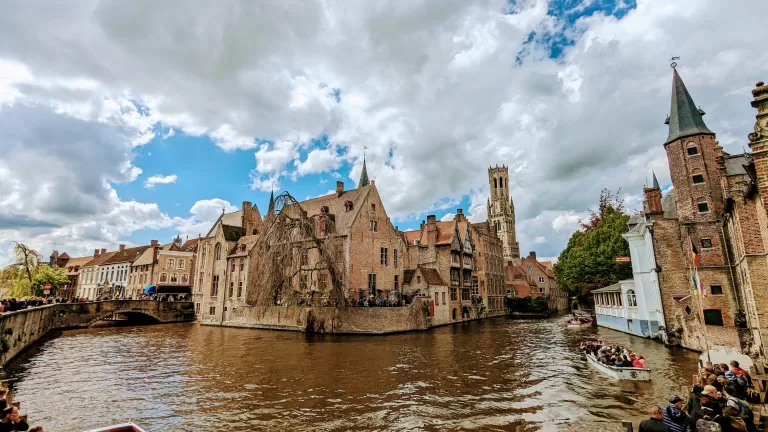
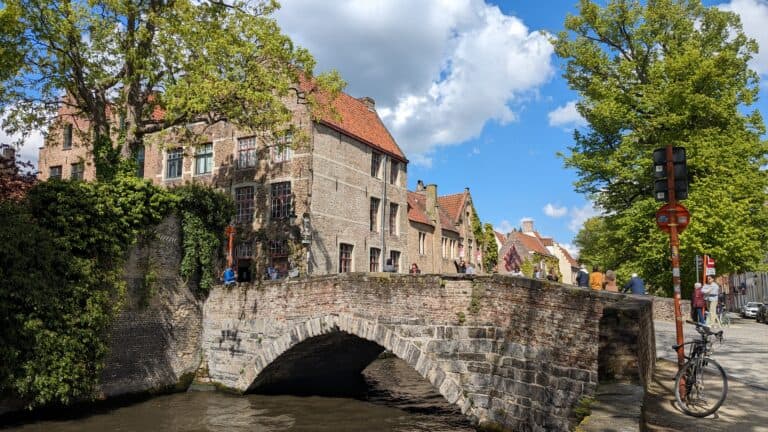
Bruges – one of the most popular day trips from Brussels. The journey takes just 1 hour by train, with departures every 30 minutes. Find more things to do in our guide to Bruges.
Ghent – another charming Flemish city that makes for an easy day trip, just 30 minutes from Brussels by train. More pretty canals, streets and buildings. See our guide to Ghent.
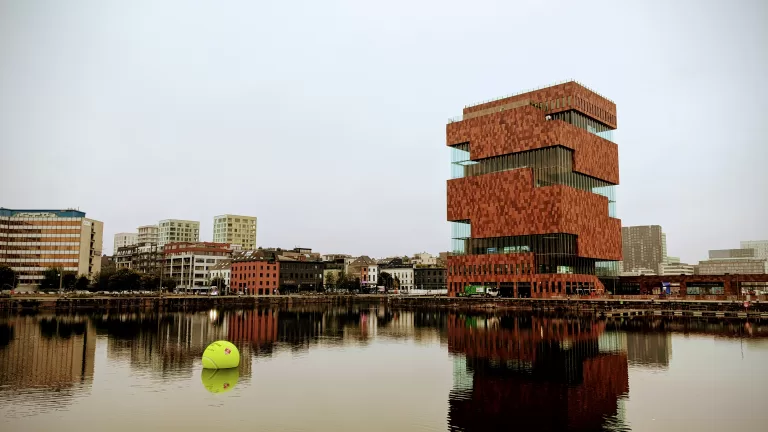
Antwerp – Belgium’s second-largest city, which has loads to see and do. The train journey takes around 1 hour from Brussels. See our guide to Antwerp.
Waterloo – a short 30-minute train ride from Brussels, Waterloo is the site of Napoleon’s defeat in 1815. The Battlefield at Waterloo has been preserved and memorialised and is a brilliant day out.
Practical tips for visiting Brussels
How long should you stay in Brussels?
We spent two full days in Brussels before moving onto Bruges via Ghent. It was long enough to wander round and see the main sights, but you’d need a bit longer if you wanted to go inside more of the tourist sites. If we’d wanted to do the Royal Museums of Fine Arts and the Magritte Museum properly, we’d definitely have stayed for three days.
If you don’t have long, you could see the main sites in one day – the historic centre is compact and walkable.
Where should you stay in Brussels?
The old town is a bit larger than most old towns, however its still quite small and walkable. We recommend staying either in the old town, or just outside so that you can still walk in. We’ve written a full breakdown of the best areas and our top hotel picks in our guide to the best hotels in Brussels.
The main station (Brussels Midi-Zuid) is in the south and the airport is in the northeast, so it’s worth factoring that in when you book.
How do you get there?
We took the Eurostar from London St Pancras, which got us to Brussels in just over two hours – it’s one of the easiest city breaks from the UK. If you haven’t taken the Eurostar before, our guide to taking the Eurostar from London to Belgium covers booking tips, luggage rules, and what to expect at St Pancras.
You’ll arrive at Brussels Midi-Zuid station, to the south of the old town. From there, it’s a 20–30 minute walk into the centre or a short taxi ride. It’s the main station you’ll need if you get the train to other Belgian cities.
You can also fly into Brussels Airport, which is about 20 minutes from the centre by train (or around an hour via bus). If you’re comparing prices, we use Kiwi.com to search flights and trains side by side.
When should you go to Brussels?
Brussels has something going on all year round. Spring and autumn are the best times to visit, as you’ll avoid the summer crowds and still get decent weather (though Brussels can be wet, so pack a waterproof). If you’re visiting over Christmas, the Christmas markets around the Grand Place and Bourse are worth the trip alone.
We went in May. The weather was a bit changeable with some rain (as you’ll see from the photos!) however it didn’t stop us enjoying Brussels and it was nice having it a bit quieter. Just plan indoor activities according to the forecast.
Can you save money with a Brussels Card?
If you’re planning to visit several museums, the Brussels Card is worth looking into. It gives you free entry to over 40 museums (including the Magritte Museum, MIM, and the Comic Strip Center) plus optional add-ons for public transport and the Atomium.
We didn’t use one on our trip because we only visited a couple of paid attractions, but if you’re staying for three or more days and want to hit the museums, it can pay for itself quickly. You can check prices and what’s included on the Visit Brussels website or purchase on Get Your Guide.
Frequently asked questions
So, why not visit Brussels?
Brussels might not have the postcard prettiness of Bruges, but it has a lot of other draws – a mix of grand squares, EU politics and a beer scene that rivals anywhere in Europe.
Whether you’ve got a single day or a long weekend, the sights above will give you a real feel for the city.
Next, why not plan a side trip? Our guides to Bruges and Ghent are a great place to start. Or, see all our Belgian content.
This article is now featured on GPSmyCity. To download this article for offline reading or travel directions to the attractions highlighted in this article, go to Walking Tours and Articles in Brussels on GPSmyCity.
A small favour: we're trying to gather some feedback to help make our blog even better
If you have any feedback on how we can improve, please add it below. Big or small, we'd love to hear.